Streets on the Table Episode 4: Georges, Jasper, and Celestin
Text
In 2019, the New Orleans City Council launched a city-wide effort to change the names of streets honoring white supremacists. While the city implemented its renaming efforts, a clear need for an educational component to give context to the changes presented itself. Filling the gap, public history graduate students at the University of New Orleans created projects to illuminate the work of the Street Renaming Commission.
Produced by the Midlo Center for New Orleans Studies, Streets on the Table is a podcast that reflects on the historical relevance of both the old and new street names. Hosted by two UNO graduate students, the podcast highlights the lives and histories unrecognized in the commemorative landscape.
In the fourth episode, Eddie and Lauren continue their discussion on self-liberating people in New Orleans. The stories of Georges, Jasper, and Celestin shine light on incarceration during slavery.
Files
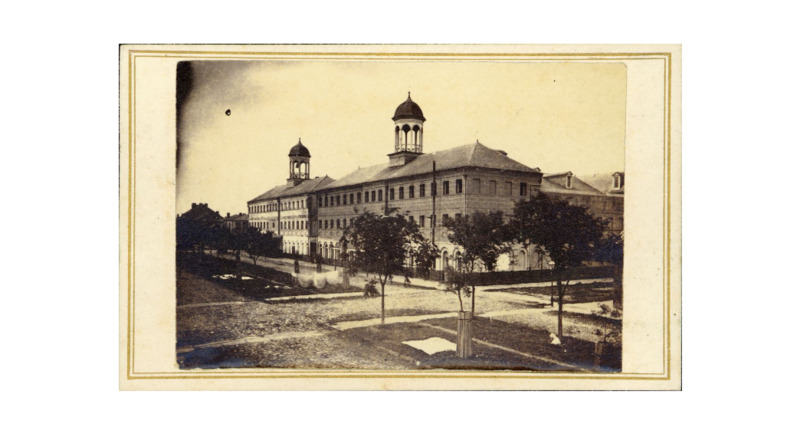
A view of the Orleans Parish Prison, where self-liberating people were held after capture and endured poor prison conditions.
Source: “Police jail & Parish prison,” Marshall Dunham Photograph Album (Mss. 3241), Louisiana and Lower Mississippi Valley Collections, LSU Libraries, Baton Rouge, Louisiana, https://louisianadigitallibrary.org/islandora/object/lsu-sc-mdp%3A179.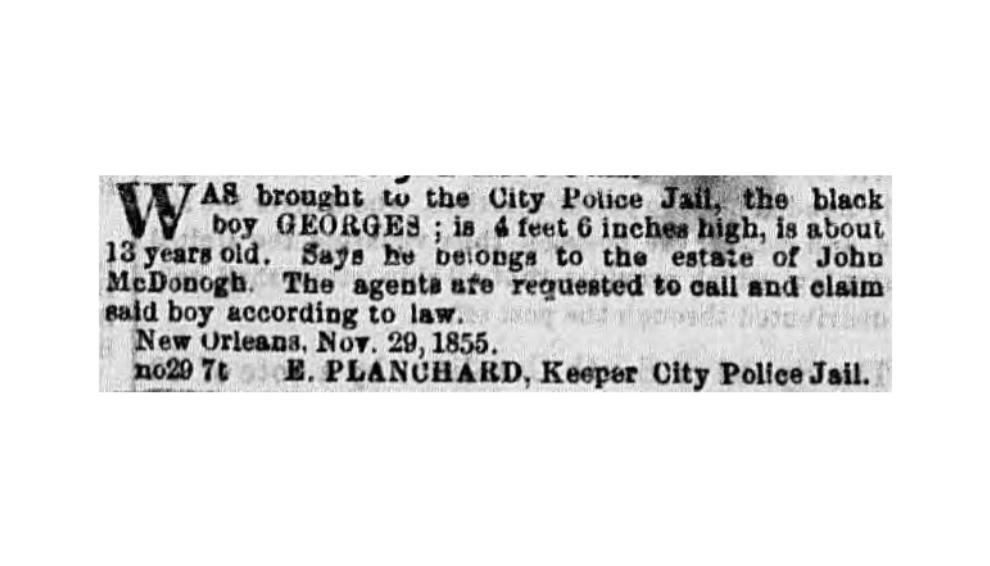
The advertisement listed in the New Orleans Daily Crescent for Georges.
Source: New Orleans Daily Crescent, 29 November 1855, Chronicling America: Historic American Newspapers, Library of Congress, https://chroniclingamerica.loc.gov/lccn/sn82015753/1855-11-29/ed-1/seq-1/.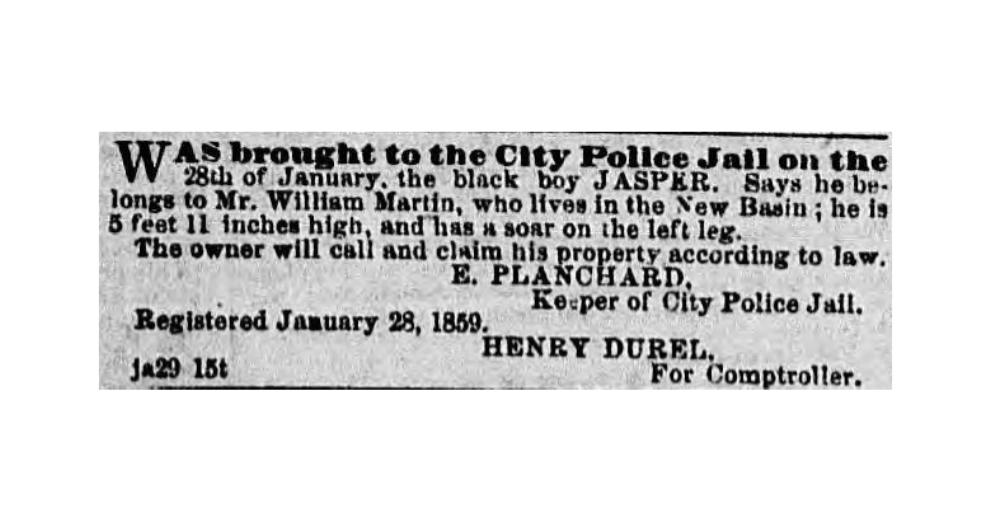
Jasper’s advertisement detailing the soar on his leg, among other information regarding his enslaver and physical description.
Source: New Orleans Daily Crescent, 29 January 1859, Chronicling America: Historic American Newspapers, Library of Congress, https://chroniclingamerica.loc.gov/lccn/sn82015753/1859-01-29/ed-1/seq-6/.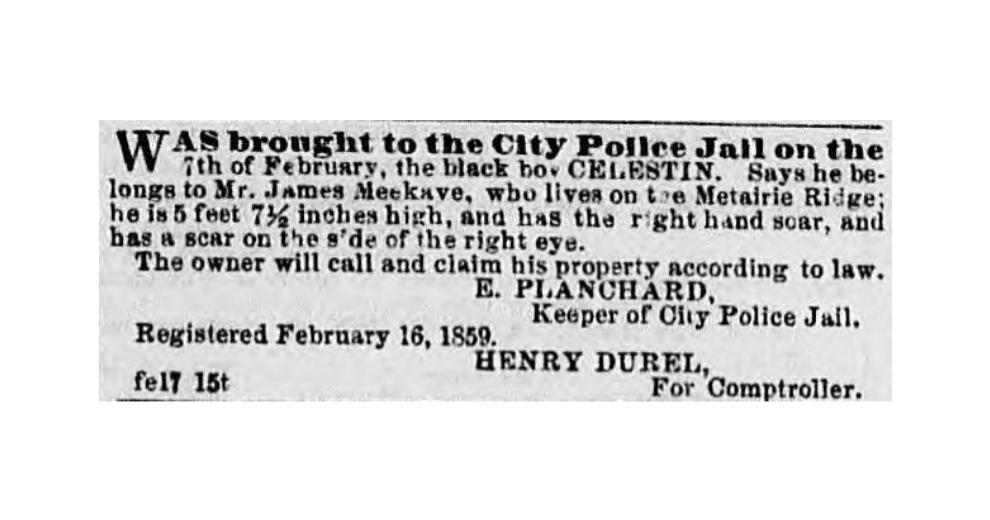
The advertisement reveals how long Celestin had been incarcerated before Planchard listed him in the newspaper.
Source: New Orleans Daily Crescent, 17 February 1859, Chronicling America: Historic American Newspapers, Library of Congress, https://chroniclingamerica.loc.gov/lccn/sn82015753/1859-02-17/ed-1/seq-6/.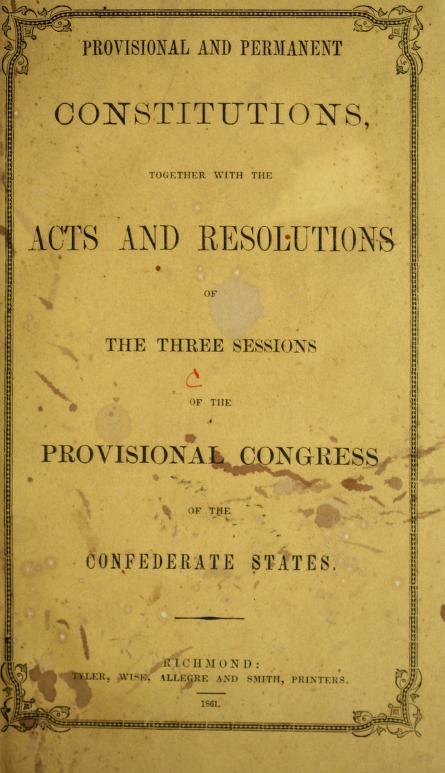
A copy of the constitution of the Confederacy.
Source: Confederate States of America, “Provisional and permanent constitutions, of the Confederate States,” (Richmond: Tyler, Wise, Allegre, and Smith, 1861), 6, Duke University Libraries, https://archive.org/details/actsresolutionso01conf/page/n5/mode/2up.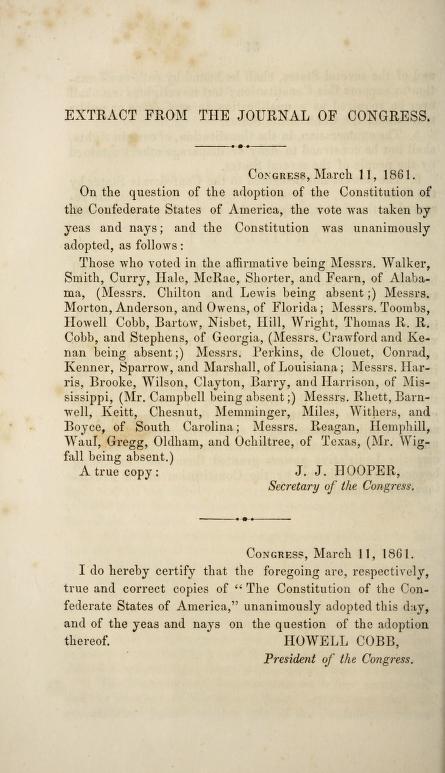
The name of Charles Magill Conrad appears as an affirmative vote for the passage of the Confederate constitution.
Source: Confederate States of America, “Provisional and permanent constitutions, of the Confederate States,” (Richmond: Tyler, Wise, Allegre, and Smith, 1861), 32, Duke University Libraries, https://archive.org/details/actsresolutionso01conf/page/32/mode/2up.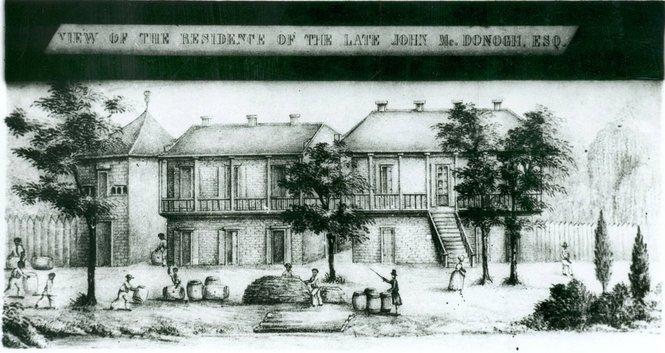
An image of McDonogh’s plantation includes enslaved people and what appears to be an overseer.
Georges might have lived here before he escaped. | Source: Artist not credited, Public domain, via Wikimedia Commons, https://commons.wikimedia.org/wiki/File:John_McDonogh_Home_1850.jpg#filehistory.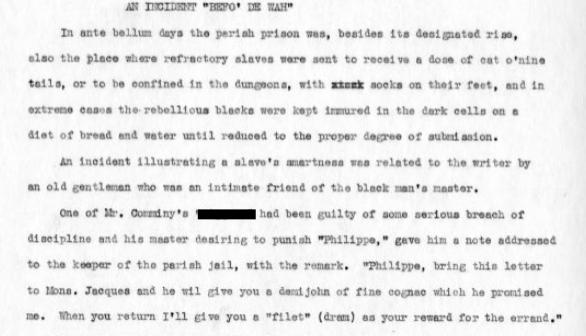
An excerpt from the Times-Picayune describes the conditions enslaved people endured in the jail, as well as how enslavers authorized the jail keeper to punish enslaved people.
*Photo edited to remove offensive language. | Source: “From the Old Prison to the New Jail,” Times-Picayune, 7, 18 January 1895, https://louisianadigitallibrary.org/islandora/object/state-lwp%3A8813.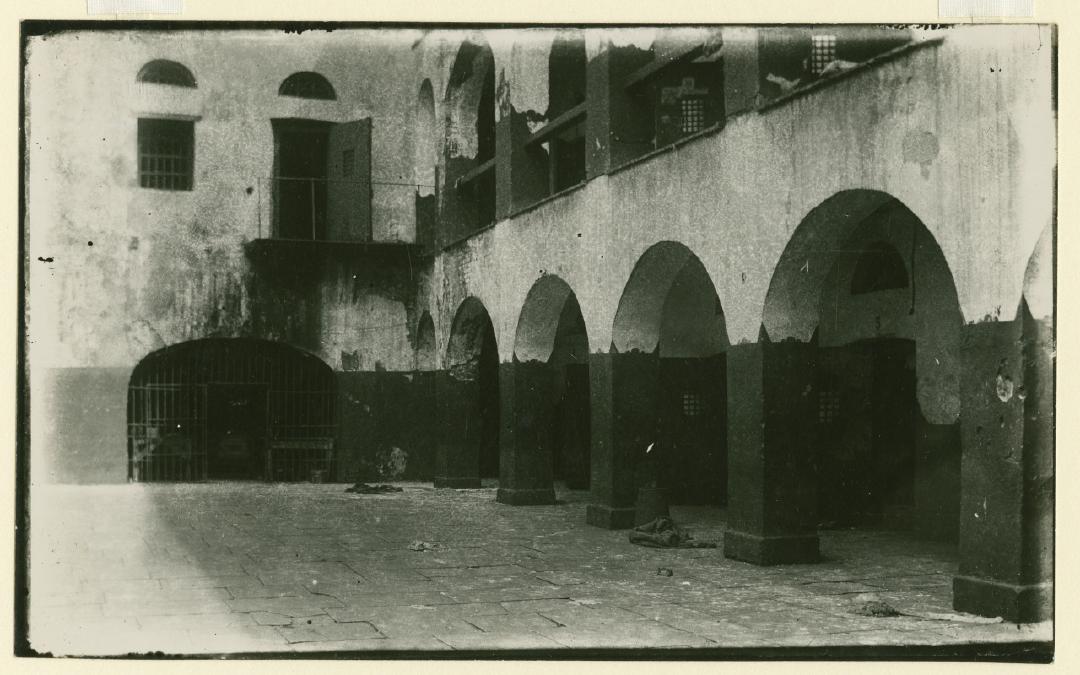
An inside look at the Orleans Parish Prison execution yard, where cells are visible.
Enslaved people were incarcerated and faced punishments here. | Source: The execution yard at the Old Parish Prison, ca. 1900, The Historic New Orleans Collection, Permanent Collection, http://hnoc.minisisinc.com/thnoc/catalog/1/32459.Streets on the Table Episode 4: Georges, Jasper, and Celestin
Map
Bragg Street, New Orleans, LA 70124 United States