The Puckett Household: 1930s Archaeology of the Melpomene Neighborhood
Text
In 2013, archaeological consulting firm Earth Search, Inc., excavated a block of the Melpomene neighborhood originally bounded by South Liberty, Erato, Clio, and Howard/LaSalle Streets. Earth Search identified brick foundations and artifacts from a number of different addresses across this particular block. The most informative materials recovered came from a wood-lined privy shaft located along a property line between two homes at 1220 and 1222-1224 Howard/La Salle Street. Archaeological findings suggest that the privy was filled during the 1930s, presumably representing a cleaning episode linked to a family moving from the house or a change in ownership. Glass bottles and containers, many of them intact, filled the privy along with a smaller collection of ceramic tablewares, personal items, and butchered animal bones.
The 1930 Census recorded a woman named Minnie Puckett as the owner of 1222 Howard Street. The Census described Minnie Puckett as a 49-year-old “Negro” widow, born in Mississippi to parents from Virginia. The Census valued the home, where she resided with her 13-year-old granddaughter, at $4400. Minnie Puckett’s thirty-year-old daughter, Lucille Puckett, rented the other side of the house. Also born in Mississippi, Lucille Puckett lived with her four daughters: Edna (10), Helen (8), Genieve (5), and Minnie (3), named for her grandmother. Minnie Puckett resided at this house until her death, after which the house appears in an advertisement for a property seizure and auction by the Civil Sheriff in 1937. By the time of the 1940 Census, the Puckett family no longer owned 1222 Howard Street. The Pucketts’ departure from the house seems like the sort of life event that caused the filling of the privy.
The archaeological assemblage from the privy gives us a small glimpse of everyday life in the household, and of the hopes and obstacles faced by Black families of this generation. The images below illustrate and describe some of the objects found in the Puckett family privy.
The Puckett family’s story epitomizes the aspirations of Black migrants to New Orleans in the early twentieth century, but it also shows the precarity of their position in a segregated society in which oppressive forces devalued their labor and sabotaged their chances of property ownership. The Pucketts moved to New Orleans from Mississippi by 1920, when both Minnie and Lucille lived at 2605 Calliope Street. Minnie was already widowed and working as a laundress. Lucille’s husband, Eddie Carr, a laborer from Alabama, and Andrew Puckett, Minnie’s son working as a brakeman on the railroad, also resided with Minnie and Lucille on Calliope Street.
It must have taken considerable hard work for the family to purchase the property on Howard Street, particularly after the death of Andrew Puckett in 1920. Legal problems surrounded Andrew’s succession, trapping Lucille in litigation issues until the late 1920s. The loss of the property must have been a devastating blow to Lucille and her family.
Of course, the Puckett family’s dreams didn’t end at the moment in time captured by the archaeological assemblage at 1222 Howard Street. Lucille’s children grew up and had families of their own, eventually moving into the Calliope Housing Project nearby. The story of the house lost at 1222 Howard Street passed through family generations as a lesson in being careful in business and personal affairs, and a warning to not be taken advantage of. Lucille’s family remembers her tough and hard-working character, taking on extra jobs to provide more for her family. She insisted that they shouldn’t be content with their lot and should strive for better. Her daughter inherited some of her tastes for fine china and elegant petticoats, symbols of affluence in a racist society structured to keep them as second-class citizens. Many of Minnie’s descendants still reside in New Orleans and saved photos of Minnie, Andrew, and Lucille that they shared with researchers for this project.
Files

Minnie Puckett
Source: Photograph courtesy of the descendants of Minnie Puckett, and her great great granddaughter Givonna Hymel-Lumpkins. | Date: Unknown, ca. 1920s
Andrew Puckett
Source: Photograph courtesy of the Puckett Family. | Date: Unknown, ca. 1918-1919
Lucille Puckett
Source: Photograph courtesy of the Puckett Family. | Date: Unknown, ca. 1940
Newspaper Advertisement for Auction at Puckett Family Home
Source: The Times-Picayune (New Orleans, Louisiana.) | Date: December 26, 1937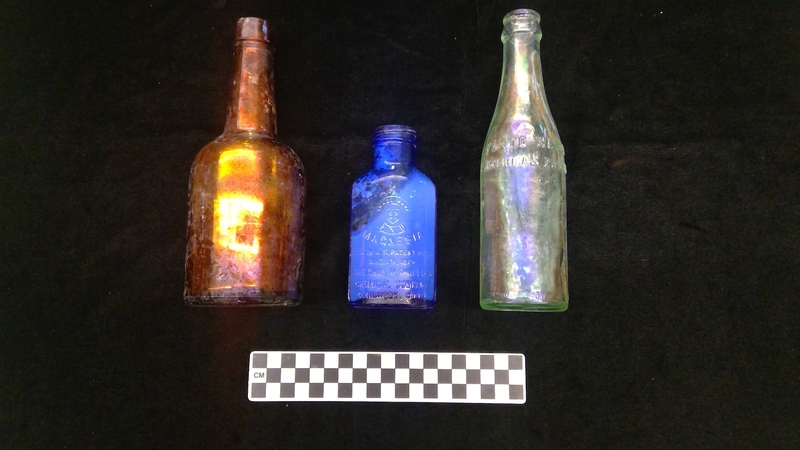
Digestive aid bottles recovered from 1222 Howard Street
In the first half of the twentieth century, brands marketed soda and mineral waters for their digestive benefits. Families in working-class neighborhoods constantly worried about the health problems related to unsanitary conditions in food and water and products like “Pluto Water” offered one solution. There were many products marketed to this end, from Johannes Hoff’s malt extract to the “Milk of Magnesia” still in common use today. This image shows Johannes Hoff’s malt extract (left), Milk of Magnesia (center), and Pluto Water (right.) | Source: University of New Orleans Department of Anthropology and Sociology | Date: 2020
Base of Pluto Water Bottle excavated at 1222 Howard Street
Pluto Water was sold in distinctive bottles with a devil-like figure on the base. The residents at 1222 LaSalle favored Pluto Water, “America’s Physic.” | Source: University of New Orleans Department of Anthropology and Sociology | Date: 2020
Advertisement for Pluto Water
Source: Times-Picayune (New Orleans, Louisiana). | Date: April 8, 1931
Advertisement for Johann Hoff’s Malt Extract
Source: The New Haven Evening Register (New Haven, CT.) | Date: February 23, 1884
Sad Iron excavated from 1222 Howard/LaSalle Street
The common “sad iron”, meant to be manually heated on a stove and used to press clothing, served as an essential tool for a laundress like Minnie Puckett. Heavy and unwieldy, this item made piece work like laundry strenuous. Not only did Minnie work as a laundress, but her family remembers stories of her using spare time to go and sell foods she prepared at the docks on the riverfront to earn extra money. | Source: University of New Orleans Department of Anthropology and Sociology | Date: 2020
City of New Orleans Button
This small piece of brass embossed with “City of New Orleans” and the city’s seal, is likely a composite button front. It may be from a button lost from a city uniform, or it may be related to Minnie’s work as a vendor. | Source: University of New Orleans Department of Anthropology and Sociology | Date: 2020
Polished bone objects from 1222 Howard/LaSalle privy
While the use of plastics gradually became more common for everyday items in the 1930s, polished bone and natural materials still formed many objects. On the left, a bone handle from a darning needle or crochet hook reminded family members of Lucille Puckett’s love of crocheting, and the picture they shared of her shows a knit shawl she likely made. The item on the right is from a piece of bone-handled cutlery, while the one in the middle is the handle from a toothbrush. These items would have been dated by the time that the Pucketts left the home on LaSalle, and thus would have been more likely to be discarded. | Source: University of New Orleans Department of Anthropology and Sociology | Date: 2020
Molded and enameled porcelain saucer from 1222 Howard/LaSalle privy
Minnie Puckett’s descendants recalled some of the tableware decorations found in the privy surviving in their great-grandmother’s china cabinet. They mentioned always wondering about the odd, unmatched pieces, but they recalled also how Lucille emphasized having stylish, elegant dinnerware. Perhaps the unmatched pieces were legacies of her own mother, carried forward from LaSalle as memories of the home that Minnie created for them there. | Source: University of New Orleans Department of Anthropology and Sociology | Date: 2020
Decorated porcelain from 1222 Howard/LaSalle privy
Source: University of New Orleans Department of Anthropology and Sociology | Date: 2020
Blue-edged and gilt plate from 1222 Howard/LaSalle privy
Source: University of New Orleans Department of Anthropology and Sociology | Date: 2020
Pocket watch case from 1222 Howard/LaSalle privy
It is rare to find valuable items discarded in privies. So often the artifacts recovered only give us hints as to the sorts of things that families kept as keepsakes. In this case, the brass pocket watch case from the Empire State Company, with its serial number still visible, would not have been as treasured as the watch mechanism itself. | Source: University of New Orleans Department of Anthropology and Sociology | Date: 2020
Metal lipstick case from 1222 Howard/LaSalle privy
This recovered Richard Hudnutt brand lipstick case, with traces of a deep red lipstick inside, hints at the style for which later generations remembered the Puckett women. | Source: University of New Orleans Department of Anthropology and Sociology | Date: 2020
Porcelain doll head and dishes from 1222 Howard/LaSalle privy
During the Victorian era, porcelain dolls and toy tea services were thought to help instill proper morals and polite behavior in children, and such items served a dual role of entertainment and instruction into the twentieth century. But for an Black family in the era of segregation, the meanings behind white porcelain dolls are murkier and more problematic. Mass-produced fashionable Black dolls were still relatively rare, and porcelain dolls seemed to represent a standard of beauty based only in whiteness, naturalizing a two-tiered racial hierarchy marginalizing Blackness. | Source: University of New Orleans Department of Anthropology and Sociology | Date: 2020