The Cabildo: The Archaeology of a Colonial-Era New Orleans Prison
Text
The excavations at the Cabildo represented a rare opportunity to recover archaeological evidence of Colonial era governance, particularly in the realm of punishment. Modern conceptions of the prison as a place of confinement and correction were still developing in this era, and serious offenses were likely to be considered a direct affront to the sovereign, and thus to be punished corporally. The evidence from the Cabildo suggests that, even at a comparatively early date, prison labor was being exploited in manufacturing, a pattern that would be developed through the nineteenth century and into the modern era. It shows the poor sanitation within the prison, but it also demonstrates the ways in which those confined maintained some degree of autonomy within those conditions.
Today, the Cabildo is a facility of the Louisiana State Museum, but the courtyard of the Cabildo was the location of a city prison complex for nearly two hundred years, across French, Spanish, and American rule. Constructed in 1730, the prison and police station were some of the city’s earliest administrative structures. In 1769, following the transition from French to Spanish rule, Spanish officials demolished the existing structure and built a Cabildo, or town hall: a complex with a military prison, a civil prison, police station, jailer’s quarters, and government chambers. The Great Fire of 1788 damaged this Cabildo and another fire in 1794 destroyed other parts of the complex. In 1799, the second Cabildo was completed, and this is the structure you see today.
In the early 1830s, the City Council authorized plans for enlarging the prison to deal with its notorious overcrowding, but the city also built a new Orleans Parish Prison behind what is today the Municipal Auditorium near Louis Armstrong Park. After the construction of the new prison finished in 1839, the old prison was abandoned and subsequently torn down. Throughout the Spanish and American periods of its operation, government officials and visitors commented on the poor condition of the facility, from lack of food and clothing to rat infestations.
In May of 1988, the third story of the Cabildo, by then a part of the Louisiana State Museum, caught fire. Following the fire, the museum hired Earth Search, Inc., led by Dr. Jill-Karen Yakubik, to excavate the Cabildo courtyard prior to the construction of a new water line in the vicinity.
Files

Casa Capitular de esta ciudad (Cabildo, 701 Chartres)
Source: Courtesy of Louisiana Division/City Archives & Special Collections, New Orleans Public Library, Governor's Office Private Dispatches of Governor Miro, 1784-1794, p. 165, Negative Number: N-1550. | Date: February 28, 1799
Composite drawing of civil prison and excavation units planned by ESI.
A total of 8.5 square meters of units were planned during the excavations by Earth Search, Inc.,, of which two 1 x 2 m units, one 1 x 1 m unit, and one 1 x 1.5 m unit were completed (the remaining two being abandoned because of subsurface concrete). The units were oriented based on overlays of historic maps with the planned route for a water line, with the goal of recovering information about the 1730 Civil Prison on the site. | Source: Reproduced from Yakubik and Franks 1997: Image courtesy of Earth Search, Inc.
Excavations at the Cabildo: Wall foundations beneath courtyard
All of the units exposed remains associated with the early-nineteenth century use of the prison complex, including floor surfaces and midden accumulations. In many cases, these later features had destroyed or made inaccessible deposits associated with the earlier 1730s prison. | Source: Collections of the UNO Archaeology Lab
Plan drawing and inset photo showing prison wall and corridor floor.
One 1 x 2 m unit placed at what would have been outside of the exterior walls of the 1730 prison encountered remains extending back to the French Colonial era of the city, demonstrating that there was further potential for such remains in the remainder of the courtyard. For instance, a brick foundation supported by timbers may have been associated with the addition of a corridor vault to the original prison structure in 1751. | Source: Figure and photo courtesy of Earth Search, Inc.
Late-Eighteenth and Early-Nineteenth Century Artifacts Recovered during Cabildo Excavations
The dig recovered abundant material from the late-eighteenth and early-nineteenth century, including both ceramics and a significant number of wine and liquor bottles. The volume of these alcohol containers was so high that they made up roughly half of the glass vessel assemblages in both the sites within the prison interior and within the courtyard. This matches accounts about whiskey rations given to prisoners. The archaeology report also implies that prisoners were supplied with a ration of tobacco due to the high volumes of smoking pipe fragments uncovered. | Source: Collections of the UNO Archaeology Lab
Buttons recovered from late-eighteenth century prison component.
Source: Collections of the UNO Archaeology Lab
Bone button blanks and manufacturing debris from prison component.
The team found eighty-five buttons in the excavation areas of the former prison interior, along with bone button blanks, or debris from their manufacture. Such buttons were made from the ribs and scapulae of domestic mammals like cows and pig. Finds of similar debris at the British military site of Brimstone Hill on St. Kitts have been associated with the labor of both soldiers and of those enslaved at the fortress, while bone debris at Parramatta/Rose Hill in Australia from a similar time has also been associated with convict labor. Incidentally, buttons recovered at the Ross Female Factory, a women’s prison also located in Australia, have been posited by Eleanor Casella as being related to informal economies and illicit barter operating within the prison. | Source: Collections of the UNO Archaeology Lab
Illustration showing identified elements of pig bone from prison excavations.
Other animal remains provided clues to the prisoners’ diet. The type of animal bones found led Yakubik and her team to conclude the prisoners ate low-quality, cheap meat although some wild game and higher quality cuts of meat were also recovered. Recovered remains of an infant pig confirmed that jailers raised livestock in the courtyard. While rats have never been an anomaly in the French Quarter, the discovery of large quantities of rat remains in close proximity with the discarded food remains paints a picture of an unsanitary environment. | Source: Figure courtesy of Earth Search, Inc.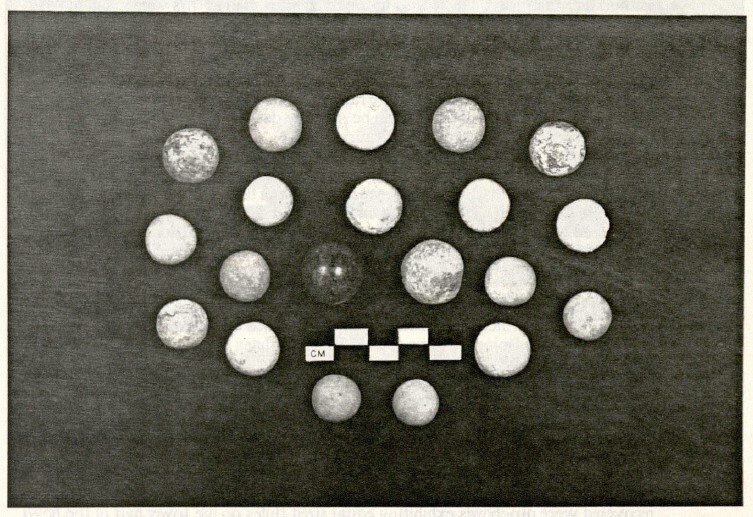
Marbles from Cabildo excavations.
Various stone marbles were also found indicating prisoner participation in gaming and gambling. This interpretation is supported by Spanish Governor O’Reilly’s ordinances that detailed jailer’s duties to prevent prisoners from gaming. The vast majority of gaming artifacts found in the dig were confined to jail cells, potentially indicating an attempt to keep such items hidden from guards. | Source: Collections of the UNO Archaeology Lab
Flint debitage from Cabildo excavations.
An unexpected find from the ESI excavations was flint debitage, created when flint nodules were shattered and worked on site. While it is possible that this was just intended as hard, manual labor for punishment, it is more likely that prisoners were also engaged in creating gunflints for use in the city’s arsenal. | Source: Collections of the UNO Archaeology Lab