<?xml version="1.0" encoding="UTF-8"?>
<feed xmlns="http://www.w3.org/2005/Atom">
  <title type="text">New Orleans Historical</title>
  <updated>2026-08-24T00:36:24+00:00</updated>
  <generator uri="http://framework.zend.com" version="1.12.20">Zend_Feed_Writer</generator>
  <link rel="alternate" type="text/html" href="https://neworleanshistorical.org/"/>
  <link rel="self" type="application/atom+xml" href="https://neworleanshistorical.org/items/browse?output=rss2"/>
  <id>https://neworleanshistorical.org/</id>
  <author>
    <name>New Orleans Historical</name>
    <uri>https://neworleanshistorical.org</uri>
  </author>
  <link rel="hub" href="https://pubsubhubbub.appspot.com/"/>
  <entry>
    <title type="html"><![CDATA[Streets on the Table Episode 1: Allen Toussaint]]></title>
    <summary type="html"><![CDATA[<img src="https://neworleanshistorical.org/files/fullsize/7a9e1fa5cf0bc06ed84f356e302286c0.jpg" alt="Allen Toussaint performs at Jazz Fest in 1989. " /><br/><p>In 2019, the New Orleans City Council launched a city-wide effort to change the names of streets honoring white supremacists. While the city implemented its renaming efforts, a clear need for an educational component to give context to the changes presented itself. Filling the gap, public history graduate students at the University of New Orleans created projects to illuminate the work of the Street Renaming Commission.</p><p>Produced by the Midlo Center for New Orleans Studies, Streets on the Table is a podcast that reflects on the historical relevance of both the old and new street names. Hosted by two UNO graduate students, the podcast highlights the lives and histories unrecognized in the commemorative landscape.</p><p>In this episode, Eddie and Lauren discuss the renaming of Robert E. Lee Blvd. to New Orleans music legend, Allen Toussaint Blvd. </p><p><em><strong><a href="https://neworleanshistorical.org/items/show/1676">For more (including 6 images&#32;&amp;&#32;1 audio file) view the original article</a></strong></em></p>]]></summary>
    <published>2022-07-28T19:45:02+00:00</published>
    <updated>2026-08-24T00:30:57+00:00</updated>
    <link rel="alternate" type="text/html" href="https://neworleanshistorical.org/items/show/1676"/>
    <id>https://neworleanshistorical.org/items/show/1676</id>
    <author>
      <name>Public history graduate students at the University of New Orleans</name>
    </author>
  </entry>
  <entry>
    <title type="html"><![CDATA[“Don’t Wear Your Good Shoes Up Here”: The Arcadia and Alamo Dance Halls of Prohibition Era New Orleans ]]></title>
    <summary type="html"><![CDATA[<img src="https://neworleanshistorical.org/files/fullsize/bbf320d7821a4b47bb8efbd8cd2f1b6e.jpg" alt="Cartoon advertisement for The Fischbein-Williams Syncopators jazz group posted at the Arcadia Dance Hall." /><br/><p>In the 1920s and 1930s, the second floor of 1001 Canal Street was home to the Arcadia and Alamo Dance Halls. These dance halls served as a space for thirsty men in New Orleans to cut loose at the height of Prohibition. Prohibition, enacted in January 1920 by the 18th Amendment, made the manufacture and sale of alcohol federally illegal throughout the United States, but nowhere housed more scofflaws than New Orleans. When Izzy Einstein, a famous 1920s customs agent, traveled to New Orleans to enforce Prohibition, he remarked that it took only thirty-five seconds to find alcohol. The driver of a taxi that Einstein hailed at the train station offered a swig of liquor from a bottle stashed beneath a seat. [2] </p><p>One of sixty-three dance halls in New Orleans, the Arcadia was known as a ‘closed,’ or ‘nickel-a-dance’ hall, primarily catering to single men without dates who would pay for dances from the women employed by the establishment. [3] The women working in these closed halls were known as ‘hostesses’ and club owners encouraged them to dance, drink, and converse with the male clientele. [4] In 1924, New Orleans Item journalist <a href="https://neworleanshistorical.org/items/show/1602">Dorothy Day</a> went undercover as a hostess in the Arcadia dance hall. Day's first-hand account of dance hall goings-on gives us an in-depth glimpse into New Orleans nightlife in the 1920s. Day describes the diverse clientele of the Arcadia as “transients, salesmen, sailors and boys from the army and navy, [and] high school boys out seeing life.” [5] Alcohol consumption was everywhere, especially in the practice of ‘B-drinking’, a scheme wherein women wokring at the dance hall would convince gullible male suitors to buy them the most expensive drinks. Police officers frequented the dance hall and often overlooked the sale of alcohol - for a fee. [6] Like most music venues in the city, jazz was the music of choice for the dance halls at 1001 Canal. The dance halls hosted a variety of jazz acts, including The Fischbein-Williams Syncopators and the world-famous banjoist/guitarist, Danny Barker. [7, 8]</p><p><em><strong><a href="https://neworleanshistorical.org/items/show/1601">For more (including 3 images) view the original article</a></strong></em></p>]]></summary>
    <published>2020-06-30T22:59:31+00:00</published>
    <updated>2026-07-15T16:20:25+00:00</updated>
    <link rel="alternate" type="text/html" href="https://neworleanshistorical.org/items/show/1601"/>
    <id>https://neworleanshistorical.org/items/show/1601</id>
    <author>
      <name>Joseph LeDesma</name>
    </author>
  </entry>
  <entry>
    <title type="html"><![CDATA[Stepping to the Rhythm: The Amphitheater and National Pan-Hellenic Council Plots]]></title>
    <summary type="html"><![CDATA[<img src="https://neworleanshistorical.org/files/fullsize/871a5aa8c2577713385a528002c9e042.jpg" alt="Delta Sigma Theta Performing at the Amphitheater." /><br/><p>The Amphitheater at UNO, along with the stretch of Leon C. Simon Drive along the front of campus, is another site used by Black Greek letter organizations for artistic expressions. The Amphitheater is a concrete stage with a grass-covered stadium style viewing area. The stage is available to all student organizations and often utilized by Black Greek letter organizations. </p><p>By the mid-1990s, amid a rise of hazing lawsuits, National Black Greek Organizations discouraged death marching and the practice declined. This era saw the rise of “New Member Presentations,” where new initiates of Black Greek organizations recited history, shared information, and performed synchronized dances called “stepping” for an audience. Each organization has its own signature steps and moves, and organizations use this show to announce their new members to the campus, much like death marching. </p><p>Black Greek organizations utilized the Amphitheater for other occasions as well. The Amphitheater was a place of artistic expression, where Black Greek organizations perform step shows, raising awareness of their presence on campus and displaying cultural pride. Displaying this cultural pride is an active form of resistance, displaying their pride in a space that had been hostile to African American students throughout its history. </p><p>The National Pan-Hellenic Council plots are located near the Amphitheater The plots are stone fixtures and benches serve as physical representations of Black Greek letter organizations on UNO’s campus. The plots are a communal space for members of Black Greek organizations, where members hang out, eat lunch, and meet. These plots serve as the largest physical representation of Black Greek organizations on campus and are treated as almost sacred by members and only utilized by the members of Black Greek organizations. </p><p><em><strong><a href="https://neworleanshistorical.org/items/show/1516">For more (including 3 images) view the original article</a></strong></em></p>]]></summary>
    <published>2019-07-12T16:36:52+00:00</published>
    <updated>2026-07-15T16:20:26+00:00</updated>
    <link rel="alternate" type="text/html" href="https://neworleanshistorical.org/items/show/1516"/>
    <id>https://neworleanshistorical.org/items/show/1516</id>
    <author>
      <name>August Darbonne&amp;#32;&amp;amp;&amp;#32;Kathryn O&amp;#039;Dwyer, Editor</name>
    </author>
  </entry>
  <entry>
    <title type="html"><![CDATA[Keep Marching On: Black Greek Organizations Performances on Leon C. Simon Drive]]></title>
    <summary type="html"><![CDATA[<img src="https://neworleanshistorical.org/files/fullsize/85aac6b90005f34ed929d06b2d64cf1a.jpg" alt="Zeta Phi Beta Death-marching at Dillard University." /><br/><p>The half mile stretch of Leon C. Simon Drive, that forms the front boundary of the University of New Orleans’s campus, was a central performance space for Black Greek letter organizations in the 1980s and 1990s. The stretch of sidewalk was the sight of “death marches,” artistic and synchronized marches performed by new initiates of Black Greek letter organizations. These marches took place when new members “came out”, announcing their status as official members of their organizations after weeks of studying fraternity/sorority history, organization, and purpose. </p><p>Marches brought out huge audiences, many of these onlookers belonged to the UNO community, including members of predominantly White Greek organizations. Marches were a rare instance when predominantly white greek organizations interacted with historically Black Greek organizations. Joan Brown-Staidum, a charter member of Zeta Phi Beta at UNO (a historically Black organization, discussed her death march during an oral history interview conducted with her by the author in 2018:</p><p>“...that was the week that you did all the studying, you didn’t come out, you didn’t do, they didn’t see us the whole entire week, until then, until the march.</p><p>“The only thing they [predominantly White Greek organizations] came to was when we were going over, we had the death march.”</p><p>This stretch of Leon C. Simon Drive was a space where members could be unapologetic and celebrate their membership in organizations that forged bonds between members and provided a support system to uphold them throughout their academic career. This performance officiated and solidified their membership, and conferred their membership into a very important and needed bond.</p><p><em><strong><a href="https://neworleanshistorical.org/items/show/1515">For more (including 2 images) view the original article</a></strong></em></p>]]></summary>
    <published>2019-07-12T16:33:00+00:00</published>
    <updated>2026-07-15T16:20:26+00:00</updated>
    <link rel="alternate" type="text/html" href="https://neworleanshistorical.org/items/show/1515"/>
    <id>https://neworleanshistorical.org/items/show/1515</id>
    <author>
      <name>August Darbonne&amp;#32;&amp;amp;&amp;#32;Kathryn O&amp;#039;Dwyer, Editor</name>
    </author>
  </entry>
  <entry>
    <title type="html"><![CDATA[A Way of Their Own: Black Greek Organizations at UNO]]></title>
    <summary type="html"><![CDATA[<img src="https://neworleanshistorical.org/files/fullsize/0c9268fb6d3783262e2b570cff2593df.jpg" alt="Delta Sigma Theta Homecoming Poster." /><br/><p>Black Greek letter organizations at UNO play an essential role for African American students as they do across the nation. Black Greek organizations provide a safe space for African Americans where communal bonds form, perform service and activism for the African American community and foster connections with the campus and its resources. </p><p>Services rendered by Black Greek organizations encourage the academic success of African Americans and function as a method of resistance against the hostilities African American students face. </p><p>Eight Black Greek organizations have chartered chapters at UNO, including:</p><p>Sigma Gamma Rho Sorority, Inc. (Gamma Pi, rechartered 2006 as Rho Delta)</p><p>Alpha Kappa Alpha Sorority, Inc. (Eta Eta ,1973)</p><p>Alpha Phi Alpha Fraternity, Inc. (Theta Phi, 1973)</p><p>Delta Sigma Theta Sorority, Inc. (Mu Tau, 1976)</p><p>Phi Beta Sigma Fraternity, Inc. (Iota Lambda, 1978)</p><p>Zeta Phi Beta Sorority, Inc. (Upsilon Iota, 1980)</p><p>Kappa Alpha Psi Fraternity, Inc. (Lambda Omicron, 1983)</p><p>Omega Psi Phi Fraternity, Inc. (Theta Mu, Unknown)</p><p><em><strong><a href="https://neworleanshistorical.org/items/show/1514">For more (including 3 images) view the original article</a></strong></em></p>]]></summary>
    <published>2019-07-12T16:28:57+00:00</published>
    <updated>2026-07-15T16:20:26+00:00</updated>
    <link rel="alternate" type="text/html" href="https://neworleanshistorical.org/items/show/1514"/>
    <id>https://neworleanshistorical.org/items/show/1514</id>
    <author>
      <name>August Darbonne&amp;#32;&amp;amp;&amp;#32;Kathryn O&amp;#039;Dwyer, Editor</name>
    </author>
  </entry>
  <entry>
    <title type="html"><![CDATA[Dawn of a New Tradition: Black Greek Letter Organizations]]></title>
    <summary type="html"><![CDATA[<img src="https://neworleanshistorical.org/files/fullsize/67a5fd46ddc27fc0ccdd395f6e09b868.jpg" alt="“LSU Board ‘Taunts’ 53 Negro Students.” " /><br/><p>On a stroll around most college campuses, you may see students wearing shirts, hoodies, and sweaters with a number of letters from Greek alphabets in a variety of colors. These students are members of Greek letter fraternities and sororities, gendered organizations with the purpose of brother/sisterhood and camaraderie. Yet Greek organizations have an interesting history and cultural divides among them. </p><p>Social Greek organizations began in the United States in the early nineteenth century. These organizations were highly exclusionary, often restricting membership to people of specific genders or races. As fraternities and sororities continued to grow, exclusionary practices began to increase, and many greek organizations' constitutions were written or ratified to restrict membership from African American students. To resists this exclusion, African American students began forming their own Greek letter organizations. </p><p>Starting in the early twentieth century, African American students formed their own Greek fraternities and sororities to foster communal bonds and increase professional opportunities after collegiate careers, but also to provide community service to the African American community. Service and activism are central principles of Black Greek organizations. Ideals of racial uplift were prominent at the time people founded many of these organizations. </p><p>The founders of Black Greek organizations were made up of a small number of African Americans in the early twentieth century that attended colleges and universities. These students attained the education and resources usually only afforded to the White population, then used those resources to educate and benefit the entire African American community in order to foster racial equality. Using these resources for racial uplift, the founders of Black Greek organizations created their organizations to benefit the African American community across the United States. They would charter chapters at multiple universities, both nationally and internationally, to spread their mission. </p><p>Nine of the largest Black Greek organizations organized into an umbrella council, the National Pan-Hellenic Council, in order to promote their common purpose. </p><p>First opened in 1958 as the Louisiana State University in New Orleans, the University of New Orleans (UNO) was the first public university in the South to open as an integrated institution. Despite its racially integrated student body, African American students at UNO faced hostilities from its earliest days to the present time, including cross burnings, intimidation tactics, unfair grading, and restricted use of spaces. Black Greek Organizations were essential resources for students admitted to UNO who faced grave discrimination from university officials, students, and the public. </p><p>To learn more about the hostilities Black Greek Letter Organizations fought and resist against, see <a href="https://neworleanshistorical.org/tours/show/53">“55 in ’58: Integrating the University of New Orleans.”</a></p><p><em><strong><a href="https://neworleanshistorical.org/items/show/1513">For more (including 2 images) view the original article</a></strong></em></p>]]></summary>
    <published>2019-07-12T16:13:25+00:00</published>
    <updated>2026-07-15T16:20:26+00:00</updated>
    <link rel="alternate" type="text/html" href="https://neworleanshistorical.org/items/show/1513"/>
    <id>https://neworleanshistorical.org/items/show/1513</id>
    <author>
      <name>August Darbonne&amp;#32;&amp;amp;&amp;#32;Kathryn O&amp;#039;Dwyer, Editor</name>
    </author>
  </entry>
  <entry>
    <title type="html"><![CDATA[Lincoln Beach]]></title>
    <summary type="html"><![CDATA[<p><strong><em>Paper Monuments Project #020</em></strong></p><img src="https://neworleanshistorical.org/files/fullsize/ce6b95274bbaf05ed9de6a6ee9c27567.jpg" alt="Paper Monument Poster #020: Lincoln Beach" /><br/><p>“Weeds, snakes, and a contaminated lake.” </p><p>These were the swimming conditions that New Orleans provided for African Americans prior to the opening of Lincoln Beach.  In 1938, Sam Zemurray, president of United Fruit Company, deeded a 2.3-acre tract of land to the city. The following year, the Orleans Parish Levee Board purchased the land. The tract was along the lakefront in the Little Woods section of New Orleans East. The city asserted that Little Woods was a ‘separate but equal’ recreational area, in compliance with the standard established in Plessy v. Ferguson.  However, many African-Americans recall a 12-mile trip on an unpaved road that was followed by crossing active railroad tracks, and waste from nearby fishing camps which polluted the swimming water. </p><p>African-Americans continued to seek out other options so they could stay cool in the tropical summers.  Some visited the nearby Seabrook in spite of police harassment and the city’s refusal to provide lighting or lifeguards. The most impactful tragedy at Seabrook occurred in 1931 when a group of six family members all drowned together due to a sinkhole in the lake. Such drownings became increasingly common as structural improvements were made along the North Shore of the lake.  Real estate investments increased the value of homes in burgeoning white communities.  Additionally, the white sand that was imported for the newly constructed and segregated Pontchartrain Beach eroded the South Shore. </p><p>After 25 years of struggle for recreational equality and environmental racism, the Orleans Levee Board invested $500,000 in building a lakeside amusement park for African-American citizens, who comprised about 200,000 — or 32% — of the city’s population in 1950. More extensively developed than the park designated in 1939, Lincoln Beach was a better-equipped site. Some remember tickets for free admission to Lincoln Beach that came in Sunbeam Bread.  There was a Midway with rides, a ferris wheel, rollercoaster, and games of chance. Patrons dined at the Carver House Restaurant, and danced atop its terrace.  </p><p>There were two swimming pools with a lifeguard corps and a swimming teacher, Edward X. Dunn.  One of the pools was named in honor of Capt. Nolan McNeal, a former slave and fighter for black progress. Highlights at Lincoln Beach included bathing beauty contests and diving expositions.  It was also the site of the annual Negro State Fairs.  Musical artists included Fats Domino, Irma Thomas, Earl King, The Neville Brothers, Nat King Cole, The Ink Spots, Ernie K-Doe, Dr. John, and many others.</p><p>Despite marked improvements, most African-Americans recognized that Lincoln Beach was a park of lesser quality than the Whites-only Pontchartrain Beach. Lincoln Beach was a quarter-mile in length in contrast to Pontchartrain Beach’s half-mile, and it was difficult to arrive at, but it was a place where African-Americans produced culture through their bodies.  And as many have said, “It was a place where I felt safe.”</p><p>Since its closure following the desegregation of public accommodations under the Civil Rights Act of 1964, Lincoln Beach has become dilapidated.  It barely shows the skeleton of what it once was.  As soon as Pontchartrain desegregated, the Orleans Levee Board abandoned caring for the beach. And once Pontchartrain Beach integrated, owner Harry Batt disinvested in his own property.  White violence was initially enacted against African-Americans that began to integrate Pontchartrain.  Eventually, whites stopped attending the park at all.  </p><p>Mr. Leon A. Waters [researcher, author, and native of New Orleans] took me [storyteller Danielle Abrams] to Lincoln Beach in the summer of 2018.  We stood on the levee looking down into a forest that blanketed the beach.  Mr. Waters said to me, “They let that forest grow so we’d forget it [segregation] ever happened.”</p><p><em><strong><a href="https://neworleanshistorical.org/items/show/1508">For more view the original article</a></strong></em></p>]]></summary>
    <published>2019-06-12T20:01:41+00:00</published>
    <updated>2026-07-15T16:20:26+00:00</updated>
    <link rel="alternate" type="text/html" href="https://neworleanshistorical.org/items/show/1508"/>
    <id>https://neworleanshistorical.org/items/show/1508</id>
    <author>
      <name>Paper Monuments, Danielle Abrams - Storyteller,&amp;#32;&amp;amp;&amp;#32;L. Jeffrey Andrews - Artist</name>
    </author>
  </entry>
  <entry>
    <title type="html"><![CDATA[Joan of Arc Statue : Joanie on the Pony: Home at Last ]]></title>
    <summary type="html"><![CDATA[<p><strong><em>Each year on January 6th, the Krewe de Jeanne d’Arc honors St. Joan and the French heritage of New Orleans with a celebration.  </p><p>"As the first day of the carnival season, that date suggests renewal-the awakened sprite carrying the battle flag from the dead of winter toward the light of Spring. Joan has given us hope. Once more she is called to battle." </p><p>-Errol Laborde </em></strong></p><img src="https://neworleanshistorical.org/files/fullsize/ce8a6960dbd5297c9a87bafac9fa3116.jpg" alt="Joan of Arc Statue Photograph #951, Undated" /><br/><p>In 1425, at the young age of thirteen, voices spoke to a French teenager named Joan telling her to provide aid to Charles VII of France in his plight against the English during the Hundred Years’ War.  Mounted on her steed, this teenage girl led the French forces to drive the English troops out of Orleans.</p><p>The ‘Maid of Orleans' continued her fight against the English until her capture in 1430 when a group of Burgundians turned her over to the British. On May 30, 1431, the British charged Joan with heresy and burned her at the stake. On July 7, 1456, the church and government absolved Joan of her crimes, and centuries later in 1909, Pope Leo XIII beatified Joan. Shortly after, in 1920, he canonized the warrior for her outstanding virtues. The presence of St. Joan, the Maid of Orleans, drifted through many centuries, over the ocean to a special place in the sister city of her hometown, New Orleans. </p><p>Originally cast by French sculptor Emmanuel Frémiet in the late 1800s, the statue of Joan that can be found in the French Quarter entered the world as one of nine similar statues. With no destination in mind, Joan patiently waited in a French warehouse until her day of liberation. Adventure finally found her in 1958 when a New York Company purchased the warehouse where Joan sat, longing for a change of scenery. While her warehouse mates traveled to places like Melbourne, Quebec, and Philadelphia, Joan traveled to one of the liveliest cities in the world, New Orleans. Though relocated to a lively city, Joan languished in storage once again, this time in a New Orleans warehouse for approximately fourteen years while the city struggled to pay her $36,500 price tag. Even though French President Charles de Gaulle paid her ransom in 1964, she remained in the dreary warehouse until 1972. Joan emerged under the Southern sun at the Rivergate Convention Center. </p><p>Dwarfed by the two giant buildings that surrounded her, Joan never gave up and stood proudly in her New Orleans Business District home. Temporarily disappearing in 1984, Joan reappeared in time for the World's Fair. Finally, in the fresh air, Joan enjoyed her freedom until her recapture by a lengthy legal battle in the 1990s when the Harrah’s Company sought to knock her off her pedestal in the Business District. Supported by her new troops - government officials, historians, and the community -  Joan charged into battle once more. In October 1999, a triumphant Joan advanced to her current location in the Place de France in the French Market. </p><p>Rearing back on her steed, Joan represents the strength, power, and perseverance of New Orleans, a city that no foe may defeat.</p><p><em><strong><a href="https://neworleanshistorical.org/items/show/1478">For more (including 6 images) view the original article</a></strong></em></p>]]></summary>
    <published>2019-04-12T02:21:11+00:00</published>
    <updated>2026-07-15T16:20:26+00:00</updated>
    <link rel="alternate" type="text/html" href="https://neworleanshistorical.org/items/show/1478"/>
    <id>https://neworleanshistorical.org/items/show/1478</id>
    <author>
      <name>Katelyn Woodel </name>
    </author>
  </entry>
  <entry>
    <title type="html"><![CDATA[Zulu Social Aid and Pleasure Club]]></title>
    <summary type="html"><![CDATA[<p><strong><em>One of the most widely sought after Mardi Gras throws is the famed Zulu Coconut. Given out annually on their Mardi Gras parade, the hand-decorated Zulu coconut, created by members of Zulu Social Aid and Pleasure Club, has become a staple to New Orleanians and visitors alike. </em></strong></p><img src="https://neworleanshistorical.org/files/fullsize/88b8fbe3c9f19668e5d46cf35229859e.jpg" alt="Louis Armstrong reigning as King Zulu, 1949. " /><br/><p>First appearing in 1909 as the Zulus, the group first had its origins in a club comprised of a group of Black men called “The Tramps.” Social groups such as the Tramps worked as communal bonds and financial insurance for members of the Black community. In 1915, Zulu paraded with their first floats, a spring wagon decorated with palmetto leaves and moss, carrying men dressed in grass skirts and black face paint. Instead of the traditional "throws" of glass beads, they handed out coconuts purchased from local markets. In 1916, in the notarial office of Gabriel Fernandez, the Zulu Social Aid and Pleasure Club incorporated.</p><p>In the early years of Zulu, the king would arrive by barge on the New Basin Canal, where he disembarked to throngs of people and lead the parade through of back streets of the Lower Garden District, Back o Town, and Treme neighborhoods.  The reign of Louis Armstrong as king in 1949 gave the club international notoriety and fame, and was the first time a celebrity monarch represented a New Orleans Carnival club.  </p><p>In 1969, the city of New Orleans invited Zulu to join the official route and celebration on St. Charles Avenue and Canal Street preceding Rex, where they are a center attraction Mardi Gras morning. But Zulu breaks the standard Uptown route to still pass down Basin Street and Orleans Ave through the historically Black Treme neighborhood. During the 1970s and 1980s membership expanded and helped grow the size of the parade and number of floats.</p><p>Throughout the years, Zulu Social Aid and Pleasure Club has become a stable to New Orleans communities, providing Christmas baskets to needy families, contributing scholarship funds, and adopting schools. And of course, every year providing coconuts to visitors and New Orleanians of each generation. Today, Zulu Social Aid and Pleasure Club's headquarters is located at 732 North Broad Street.</p><p><em><strong><a href="https://neworleanshistorical.org/items/show/1469">For more (including 3 images) view the original article</a></strong></em></p>]]></summary>
    <published>2019-04-01T20:59:57+00:00</published>
    <updated>2026-07-15T16:20:26+00:00</updated>
    <link rel="alternate" type="text/html" href="https://neworleanshistorical.org/items/show/1469"/>
    <id>https://neworleanshistorical.org/items/show/1469</id>
    <author>
      <name>August Darbonne</name>
    </author>
  </entry>
  <entry>
    <title type="html"><![CDATA[Tivoli Circle]]></title>
    <summary type="html"><![CDATA[<img src="https://neworleanshistorical.org/files/fullsize/fb38c4927af5e7697d8c70a44ae208ed.jpg" alt="&quot;Villa d&#039;Este, Tivoli, Lazio, Italy. Wall fountain.&quot;" /><br/><p>Long ago before there was Lee Circle, the circular park that connected Faubourg Santa Maria (today’s Central Business District) and the Lower Garden District in New Orleans was called Place du Tivoli. Also known also as Tivoli Gardens or Tivoli Circle, the park’s name derives from the legendary beauty of the centuries-old gardens in Lazio, Italy and is usually associated with public garden parks in Europe.</p><p>In such settings, the Tivoli name is often used to conjure images of paradise. In New Orleans, famous engineer, architect, and city surveyor, Barthélémy Lafon, incorporated the circle park into his urban plan design in the new faubourgs upriver. Placing the park along the grand avenue leading into the neighborhood, Lafon imagined a place for entertainment and amusement, encircle his garden with canals that interlaced the lower Garden District similar to Venice, Italy. This romantic and European-inspired recreation would become Place du Tivoli. Tivoli Circle would become an area welcome to circuses, social events, and even a carousel during the 19th century. </p><p>Lafon’s surrounding street names also reflect the popular vogue of Greek Classical culture and history of the 1810s. Lafon intended Tivoli circle to announce the transition of St. Charles Ave to the Cours des Naiades, after legendary freshwater Greek nymphs, and Cours des Tritons, or Triton’s Walk along present day Howard Avenue, in reference to Poseidon’s powerful triton staff from Greek mythology. Although the city did not keep these two earlier names, Lafon’s plan included “The Harp of the Nine Muses” located near the circle, which geographically creates the shape of a harp with the parallel “strings” named after each of the nine lovely Greek goddesses of the arts.</p><p>In 1833, the New Orleans and Carrollton Railroad was chartered and opened for business just two years later. Today, these tracks have been updated for use by the St. Charles Avenue Streetcar Line. The railroad served to connect the city of New Orleans with its growing suburbs in areas like Carrollton. The train track cut through Tivoli Circle in an arc, traveling along Triton’s Walk to Baronne Street, where it continued into the city to Poydras.</p><p>Tivoli Circle served as the main link between Downtown New Orleans and Uptown neighborhoods and is still a popular location to meet and celebrate for Mardi Gras parades. During the Union occupation of New Orleans during the Civil War, troops camps on Tivoli Circle with their cannons and weaponry.</p><p>When Robert E. Lee died in 1870, just five years following the end of the Civil War, the Robert E. Lee Monumental Association formed. After fourteen years of private funding and planning by the Association, the statue of General Robert E. Lee was erected on February 22, 1884. The 7,000lb., 16.5ft. bronze statue stood atop a 90-foot Tennessee marble column at Tivoli Circle, a site donated by the New Orleans City Council. After standing for nearly 133 years, the statue of Robert E. Lee was removed from Lee Circle in 2017. The Tivoli name has come up in other venues within the neighborhood around its former home through restaurants and senior apartment buildings. Tivoli Circle served as a city center in many ways, having been at the focus of many important buildings that have come and gone. While the circle’s title, social, and political purpose has changed over the past two centuries, the area that was originally Place du Tivoli remains an icon of travel, commerce, and social gathering within the city of New Orleans.</p><p><em><strong><a href="https://neworleanshistorical.org/items/show/1468">For more view the original article</a></strong></em></p>]]></summary>
    <published>2019-03-25T21:24:58+00:00</published>
    <updated>2026-07-15T16:20:26+00:00</updated>
    <link rel="alternate" type="text/html" href="https://neworleanshistorical.org/items/show/1468"/>
    <id>https://neworleanshistorical.org/items/show/1468</id>
    <author>
      <name>Shelby Loyacano</name>
    </author>
  </entry>
  <entry>
    <title type="html"><![CDATA[Les Pierres]]></title>
    <summary type="html"><![CDATA[<p><strong><em>“Always the dance floor. Always the music.” And “always a lot of sexual energy.”</em></strong></p><img src="https://neworleanshistorical.org/files/fullsize/b61897268af58185c7b043932721dab6.jpg" alt="Paper Monuments Poster #027: Les Pierres" /><br/><p>Juanita Pierre and her partner Leslie Martinez opened Les Pierres, the first Black lesbian owned bar in New Orleans, in the 1980s. Located on the corner of Pauger and Rampart Streets in the Marigny, their Saturday night crowd spilled out of the bar’s French doors and onto the street. Known for their drag queen and king shows, it was a place where “anyone was welcome.”</p><p>In some sense, this scene at Les Pierres was nothing new. Queers have paraded Rampart Street, found lovers in dark French Quarter bars, starred in gender-bending variety shows, and visibly defined the nightlife of the city since at least the 1920s. Queer women have long labored in the larger economy of sex and entertainment tourism here. Some bars they frequented were a part of the hustle economy and some were a relief from it: The Starlet Lounge, the Goldenrod Inn, Miss Kitty’s. Les Pierres was the kind of place locals went after their late shifts in the Quarter had ended. What was new about Les Pierres and this particular moment in lesbian bar culture was that, beginning in the 1950s with Dixie Fasnacht of Dixie’s Bar of Music, women now owned and operated these businesses for themselves. They joined the ranks of Brady’s, Charlene’s, Pinstripes and Lace, Rubyfruit Jungle—at least a dozen bars in total—that were women-run bars catering to lesbian patrons from the 1950s to the early 2000s in New Orleans.</p><p>“We did it for us,” Pierre firmly declares in her recent interview with “Last Call,” a podcast dedicated to the stories of people who experienced the thriving (and now non-existent) lesbian bar culture of that era. The stakes were high. Outside the doors of Les Pierres was a culture dedicated to profiting from these women while violently limiting their experiences, desires, and mobility, especially those who challenged gender and racial norms. But that culture was not simply outside the doors, safely at a distance.</p><p>A long history of police brutality and harassment in particular threatened what this community continually created together. The 1950s saw large-scale raids of bars frequented by gays and lesbians. In 1953, one lesbian bar in New Orleans was raided 78 times by the police. Women were frequently charged with lewd conduct, being improperly attired in men’s clothing, and having no visible means of employment. After arrest, their names and addresses were printed in the papers, and if they had jobs, they usually lost them.</p><p>By the 1960s popular white lesbian bars like Brady’s anticipated police surveillance and so limited dancing and touching in the bar, insisting on feminine attire for their clientele. Bar patrons and bar owners paid off police and the mafia in hopes of avoiding being targets of vice squads. Upon arrest, white women faced shame and stigma, while Black women faced time in state prisons. In the long glare of Jim Crow, gay and lesbian bars have been as segregated as the rest of social, political, and economic institutions of the city. Though often targets of state violence, white lesbian bars enforced the status quo as much as they challenged it.</p><p>When Les Pierres opened, they defied the past prohibitions on intimacy between women and the enforcement of gender norms. They created an erotic space of defiance for women of color. The energy of collective organizing was nurtured in spaces like Les Pierres. These bars were spaces of political incubation where radical visions and lifelong friendships were born.</p><p>And so in the dance, the music, the sexual energy of Les Pierres was a long legacy of electric resistance.</p><p><em><strong><a href="https://neworleanshistorical.org/items/show/1462">For more view the original article</a></strong></em></p>]]></summary>
    <published>2019-03-11T21:50:58+00:00</published>
    <updated>2026-07-15T16:20:27+00:00</updated>
    <link rel="alternate" type="text/html" href="https://neworleanshistorical.org/items/show/1462"/>
    <id>https://neworleanshistorical.org/items/show/1462</id>
    <author>
      <name>Paper Monuments, Monica Kelly, Artist,&amp;#32;&amp;amp;&amp;#32;Elizabeth Steeby, Storyteller</name>
    </author>
  </entry>
  <entry>
    <title type="html"><![CDATA[Confetti Park:  Where Imagination, Fun, and Magic Fill the Air]]></title>
    <summary type="html"><![CDATA[<img src="https://neworleanshistorical.org/files/fullsize/3bf5115e6c623373c6c124a12e66ea47.jpg" alt="&quot;Krewe Of Confetti Kids&quot; " /><br/><p>Confetti Park is a whimsical, magical playground for kids.  </p><p>Landscape architect Christopher Friedrichs and sculptor Steve-Kline designed Confetti Park in 1996 on land that was a legacy of the Duverje family and home of Algiers' first firehouse (1851). The park derives its name from the Kline's sculptural aluminum fence which is decorated with a pierced confetti pattern.  According to a Times-Picayune article, Kline "lavished all his craftsmanship on the fence, treating it as seriously as any sculpture. Speaking of the park prior to its 1996 renovation, Friedrich noted that "there was a broken-down fence on the site when we arrived, and our first decision was that it needed replacing. The new fence gives the playground a special signature: it looks like a fun version of a picket fence and relates to the scale of this residential neighborhood.</p><p>Today the park is home to playground equipment, suitable for children aged 2-12, picnic tables, cypress trees, and a small chipped area suitable for running and playing. </p><p>Confetti Park was not always so kid-friendly.  In fact, in her 2002 article, “Playing it Safe,” Juliette Guilbert reports that the park, “like many of New Orleans’ 100-plus playgrounds, was desperately in need of renovation.”  Neighborhood parents called one piece of equipment “the Tower of Death . . . a 12-foot-tall cone fashioned from metal bars and covered with several layers of chipping paint . . .  no protective surfacing under the Tower – nor under the park’s swings or old metal slide.” (Guilbert)  So, as other neighborhoods around the city, Algiers Point residents organized in 2000 and “took matters into their own hands to rescue dilapidated and dangerous playgrounds,” and ultimately, in 2002, they incorporated as Confetti Kids Inc, a nonprofit organization with 70 member families.  Kristin Gisleson-Palmer, at that time co-president of Confetti Kids Inc., said the organization was searching for funding to create “a playground that is reflective of our community and inspiring to our children." (Guilbert) And, so they did.  Working to fulfill their mission “to preserve, enhance, and protect our parks to enrich the quality of life for present and future generations in a safe and secure environment in Algiers Point,” during the next three years, not only did they do a complete overhaul of Confetti Park, but they also “worked in partnership with the Algiers Point Association, Art Council of New Orleans, Friends of NORD, Old Algiers Mainstreet Corp., and NORD to achieve the renovation of Delcazal Playground,” just a few blocks away. (Confetti Kids Website)</p><p>Along with the playground, Confetti Park also hosts lots of fun activities, such as parties, puppet shows, bicycle races, music events.  In addition, there are annual events, such as the Krewe of Confetti Kids Mardi Gras Parade, the Friendship Day Parade, the Easter Egg Hunt, the Candy Land Ball,  the Spooktacular Halloween Party, and Christmas events. </p><p><em><strong><a href="https://neworleanshistorical.org/items/show/1460">For more (including 5 images) view the original article</a></strong></em></p>]]></summary>
    <published>2019-02-28T03:28:14+00:00</published>
    <updated>2026-07-15T16:20:27+00:00</updated>
    <link rel="alternate" type="text/html" href="https://neworleanshistorical.org/items/show/1460"/>
    <id>https://neworleanshistorical.org/items/show/1460</id>
    <author>
      <name>Ann Cobb&amp;#32;&amp;amp;&amp;#32;Kathryn O&amp;#039;Dwyer, editor</name>
    </author>
  </entry>
  <entry>
    <title type="html"><![CDATA[Danny Barker’s Birthplace]]></title>
    <summary type="html"><![CDATA[<img src="https://neworleanshistorical.org/files/fullsize/f86b80bd09753edeb4dfc2659160e9d2.jpg" alt="&quot;Danny Barker.&quot;" /><br/><p>Musician, educator, author and storyteller Danny Barker was born in 1909 in the rear building at 1027 Chartres Street. At the time of Barker's birth, the lower French Quarter community was home to a large African American and Sicilian population.</p><p>Barker grew up in a creole family that embraced music education and formal brass band performance. Known as the "Banjo King of New Orleans" in the 1920s, Barker toured with local bands along the Gulf Coast. Seeking new opportunities, Barker moved to New York in the 1930s, where he worked with Cab Calloway, Charlie Parker, and other legends. According to Barker: “If you went on the road with [Sam] Morgan, you would play Bay St. Louis, Pensacola, and Mobile. You would stay in Mobile and play Friday, Saturday and Sunday. You would do to same thing when you came back, when you would go through Bogalusa.” </p><p>Moving back to New Orleans in the 1960s, Barker sparked a local brass band revival when he established the Fairview Baptist Brass Band to mentor a new generation of young men in New Orleans' distinct brass band traditions. Local musicians Leroy Jones, Greg Stafford, Michael White, and many others played in the Fairview, and the Dirty Dozen Brass Band evolved from former members in the 1970s.</p><p>From the 1960s until his death in 1994, Danny Barker and his wife Blue Lu Barker often worked as educators, recorded music, and performed together. An authentic New Orleans raconteur, Barker educated audiences with his entertaining stories and detailed memories. The annual Danny Barker Banjo and Guitar Festival celebrates his multifaceted and enduring legacy.</p><p><em><strong><a href="https://neworleanshistorical.org/items/show/1325">For more (including 2 images) view the original article</a></strong></em></p>]]></summary>
    <published>2016-11-01T21:48:50+00:00</published>
    <updated>2026-07-15T16:20:28+00:00</updated>
    <link rel="alternate" type="text/html" href="https://neworleanshistorical.org/items/show/1325"/>
    <id>https://neworleanshistorical.org/items/show/1325</id>
    <author>
      <name>Brennon Slieff, Kathy Bradshaw,&amp;#32;&amp;amp;&amp;#32;Courtney Carver</name>
    </author>
  </entry>
  <entry>
    <title type="html"><![CDATA[The Lyric Theatre]]></title>
    <summary type="html"><![CDATA[<p><strong><em>New Orleans' largest African American vaudeville theater in the 1920s hosted many jazz, blues and vaudeville stars, and featured the John Robichaux Orchestra.</em></strong></p><img src="https://neworleanshistorical.org/files/fullsize/33762b3253bad527ac3c5b73ffa93521.jpg" alt="&quot;Lyric Theater.&quot;" /><br/><p>During the 1920s, the Lyric Theater was New Orleans premiere African American vaudeville theater.</p><p>Formerly located at the downtown-lake corner of Burgundy and Iberville streets in the French Quarter, the Lyric Theater was touted as “America’s Largest and Finest Colored Theater." The playhouse catered to great musicians and featured the orchestra of locally prominent violinist and bandleader Professor John Robichaux. The orchestra was adept at performing both hot jazz and more formal orchestral music.  Pianist Margaret Maurice, drummer Zutty Singleton,  clarinetist Alphonse Picou, and cornetist Andrew Kimball all performed in the orchestra.</p><p>From 1919 to 1927, the theater hosted well-known singers, dancers, and entertainers working the Theater Owners Booking Assoc. (TOBA) black vaudeville circuit, including Esther Bigeou, Sara Martin, Josephine Baker, and Ethel Waters.</p><p>The theater often held "midnight frolics" for white-only audiences. Local white newspapers promoted these midnight performances as the latest popular entertainment for their white patrons.</p><p>Cornetist/Trumpeter Punch Miller, in a Hogan Jazz Archives interview, remembered: "The Lyric used to be crowded every day in the week, upstairs and downstairs. A group would come for a week, start a new show Monday, play it Monday, Tuesday, and Wednesday. Then on Thursday they would change the show, have the same cast, but a different show. Friday and Saturday they had "midnight rambles" which were different, a little nasty. They started at 11, ended at around 2 am. They would let the white people in on "ramble" nights." [3]</p><p>Louis Armstrong also remembered the Lyric with fondness:   "I went to the Lyric Theater quite often. Located downtown on Iberville and  Burgundy streets. Robichaux Orchestra was always the best. They all read music. John Robichaux. They used to play for the stage shows. Andrew Kimball was the cornetist in the band (my choice)."  [4]</p><p><em><strong><a href="https://neworleanshistorical.org/items/show/1316">For more (including 2 images) view the original article</a></strong></em></p>]]></summary>
    <published>2016-11-01T21:06:55+00:00</published>
    <updated>2026-08-24T00:35:46+00:00</updated>
    <link rel="alternate" type="text/html" href="https://neworleanshistorical.org/items/show/1316"/>
    <id>https://neworleanshistorical.org/items/show/1316</id>
    <author>
      <name>Brennon Slieff, Kathy Bradshaw, Courtney Carver,&amp;#32;&amp;amp;&amp;#32;Charles Chamberlain</name>
    </author>
  </entry>
  <entry>
    <title type="html"><![CDATA[The Tango Belt]]></title>
    <summary type="html"><![CDATA[<p><strong><em>This entertainment district in the Upper French Quarter was a center of music and theater performance in the 1920s for both black and white patrons.</em></strong></p><img src="https://neworleanshistorical.org/files/fullsize/9ec80a85c335b685d18b9cf818137aa5.jpg" alt="&quot;Beach Tango, Brighton, ca. 1910.&quot; " /><br/><p>In the 1910s and 1920s, the Tango Belt was a popular entertainment section of the upper French Quarter, and where dance halls featured local jazz.</p><p>Named after the Argentine dance that swept the globe in 1913, the Tango Belt spanned several blocks bound by St. Louis, Dauphine, Iberville and North Rampart.</p><p>A mix of bars, cabarets, nightclubs, vaudeville houses, saloons, dance halls and theaters—of which the Lyric Theatre was one, the Tango Belt was the densest collection of jazz clubs in the city during its prime in the 1920s. </p><p>Some of the most popular jazz clubs in the 1920s included the Fern Dance Hall and Pup Cafe (1000 block of Iberville), the Dog House (Bienville at Rampart), the Orchard (900 block of Conti), and the Cadillac Club (300 block of N. Rampart). Many of these clubs hosted jitney dances, in which patrons paid to dance with women, and which also provided jobs for musicians.</p><p>After the closing of Storyville in 1917, the Tango Belt inherited much of the prostitution trade. Norma Wallace, known as the “Last Madame,” operated her brothel at 1026 Conti from the 1920s through the 1960s, and it was considered one of the last hold-overs of that trade from the 1920s.</p><p>"The women in [the Budweiser] they was a bunch of characters. There was "Broken Dishes" that was her name.  [Clarinetist Irving] Fazola's broad was Bebe, she was little....The big shot guys, they'd pick up the girls in the front,...But that love - it ain't for keeps."</p><p>-Drummer Sal Gutierrez, Hogan Jazz Archive</p><p><em><strong><a href="https://neworleanshistorical.org/items/show/1315">For more view the original article</a></strong></em></p>]]></summary>
    <published>2016-11-01T20:58:39+00:00</published>
    <updated>2026-07-15T16:20:28+00:00</updated>
    <link rel="alternate" type="text/html" href="https://neworleanshistorical.org/items/show/1315"/>
    <id>https://neworleanshistorical.org/items/show/1315</id>
    <author>
      <name>Brennon Slieff, Kathy Bradshaw, Courtney Carver,&amp;#32;&amp;amp;&amp;#32;Charles Chamberlain</name>
    </author>
  </entry>
  <entry>
    <title type="html"><![CDATA[Storyville District]]></title>
    <summary type="html"><![CDATA[<p><strong><em>A legalized prostitution district associated with the early development of New Orleans-style jazz existed from 1897-1917. Romanticized by early historians as the birth-place of jazz, this red-light district included brothels, bars and dance halls where jazz artists performed and socialized.</em></strong></p><img src="https://neworleanshistorical.org/files/fullsize/6c47127edf5383f4799d84499be6f954.jpg" alt="Close up of Storyville neighborhood from Sanborn Fire Insurance Map." /><br/><p>Standing at the intersection of Basin and Conti Streets and facing just west of St. Louis Cemetery #1, is the former location of the Storyville district in the Tremé neighborhood. </p><p>From 1897 to 1917 New Orleans established a centralized prostitution district known as Storyville, named after the city alderman Sidney Story who sponsored the creation of the district. Storyville was bound by Iberville, Basin, St. Louis, and North Robertson Streets. </p><p>In this period, upscale brothels in mansions such as Lulu White’s Mahogany Hall lined Basin Street and employed parlor pianists such as Jelly Roll Morton. On the backstreets Fewclothes’ Cabaret, Pete Lala’s, the 101 Ranch, and the Tuxedo Dance Hall provided many of jazz’s most notable performers with stable income and an environment in which they could hone their various musical styles. </p><p>In 1917, the district closed in upon order from the U.S. Navy, and the neighborhood was razed in 1939 to make way for the Iberville public housing development for low-income white residents. </p><p>The closing of Storyville provided romanticized lore regarding the birth and spread of jazz. This legend emphasizes the closing of Storyville as a catalyst for musicians leaving New Orleans and spreading the style. In fact, jazz musicians performed throughout the city from before World War I well into the 1920s and 1930s.</p><p>1216 Bienville Street, now a local corner store, is the site of Frank Early’s My Place Saloon, one of only three remaining structures from the Storyville period. Tony Jackson, considered to be one of the great piano professors of the period, worked at Frank Early's before moving to Chicago in 1912.</p><p>"I also looked forward to every night in the Red Light District, when I was delivering Stone Coal to the girls working in those Cribs. I could hear these wonderful jazz musicians playing music the way it should be played." -  Louis Armstrong [6]</p><p>"It's not true that nothing happened after Storyville closed. [In New Orleans] before and after Storyville closed there were so many great jazz musicians, so many cats all the way down the line. Buddy Petit, Kid Rena, Sidney Desvignes, Sam Morgan, Punch Miller....there was plenty of work with vaudeville and minstrel shows, roadhouses, circuses, riverboats, and lake-boat excursions, as well as circuits and tours that traveled the South."</p><p>-Musical Artist/Educator Danny Barker</p><p><em><strong><a href="https://neworleanshistorical.org/items/show/1307">For more view the original article</a></strong></em></p>]]></summary>
    <published>2016-10-30T00:32:21+00:00</published>
    <updated>2026-07-15T16:20:28+00:00</updated>
    <link rel="alternate" type="text/html" href="https://neworleanshistorical.org/items/show/1307"/>
    <id>https://neworleanshistorical.org/items/show/1307</id>
    <author>
      <name>Helen Bouzon , Jessica Jennings,&amp;#32;&amp;amp;&amp;#32;Charles Chamberlain</name>
    </author>
  </entry>
  <entry>
    <title type="html"><![CDATA[The Iroquois Theater ]]></title>
    <summary type="html"><![CDATA[<p><strong><em>Louis Armstrong won a talent show as a youth after dipping his face in flour and performing at The Iroquois Theater.</em></strong></p><img src="https://neworleanshistorical.org/files/fullsize/cd322b95883b077374d4c6ab70bc6125.jpg" alt="The Iroquois Theater, 2016." /><br/><p>The red brick building next door to The Eagle Saloon is the former home of The Iroquois Theater.</p><p>This African American vaudeville and movie theater operated from 1911-1920.  One of the first theaters to feature jazz in a concert setting, it was eventually eclipsed by the larger Lyric Theater that opened in 1920.</p><p>In the era of Jim Crow, new, independent theater houses dedicated to African American performers and audiences opened throughout the South. The "Back of Town" neighborhood in the 400 block of South Rampart was a hub of African American entertainment and socializing in  New Orleans.</p><p>As a young teen growing up in the "Back of Town" neighborhood, Louis Armstrong frequented movies at the theater, and he once won a talent show after he dipped his face in flour, an ironic twist on the usual practice of performing in blackface.</p><p>"Some nights we would see moving pictures at the Iroquois Theater---10 cents each for May Ann + Tom, 5 cents for Mama Lucy, + me. (I won an amateur contest ---  dip face in flower [flour]." - Louis Armstrong [1]</p><p><em><strong><a href="https://neworleanshistorical.org/items/show/1301">For more view the original article</a></strong></em></p>]]></summary>
    <published>2016-10-15T19:09:26+00:00</published>
    <updated>2026-07-15T16:20:28+00:00</updated>
    <link rel="alternate" type="text/html" href="https://neworleanshistorical.org/items/show/1301"/>
    <id>https://neworleanshistorical.org/items/show/1301</id>
    <author>
      <name>Joseph Cripple, Mindy Jarrett,&amp;#32;&amp;amp;&amp;#32;Charles Chamberlain</name>
    </author>
  </entry>
  <entry>
    <title type="html"><![CDATA[Hotel Monteleone]]></title>
    <summary type="html"><![CDATA[<img src="https://neworleanshistorical.org/files/fullsize/8cfb3db2a9fed87b47cf582ea7fe5541.jpg" alt="&quot;Hotel Monteleone Poster.&quot;" /><br/><p>In 1886, Antonio Monteleone purchased what was to become the Hotel Monteleone in New Orleans. Since 1886, four generations of the Monteleone family have owned the hotel, making it one of the last family-owned and operated hotels in New Orleans. [1]</p><p>In the 1880s and early 1900s, many Italian immigrants, especially Sicilians, came to New Orleans. By the end of the 1890s, more than 2,000 Italians were coming to New Orleans each year. One such Sicilian immigrant was Antonio Monteleone. </p><p>Antonio worked as a shoe cobbler in the city in a shop across the street from the Commercial Hotel. Antonio purchased the hotel in 1886 and enlisted Toledano & Wogan Architects to add thirty rooms to the hotel in the very first year. </p><p>In 1902, Mr. Monteleone purchased more property on Exchange alley that became a major addition to the Commercial Hotel. [3] In 1905 Monteleone renamed it the Hotel Monteleone. More rooms were continuously added throughout the 20th century.</p><p><em><strong><a href="https://neworleanshistorical.org/items/show/1242">For more view the original article</a></strong></em></p>]]></summary>
    <published>2016-03-28T20:12:33+00:00</published>
    <updated>2026-07-15T16:20:28+00:00</updated>
    <link rel="alternate" type="text/html" href="https://neworleanshistorical.org/items/show/1242"/>
    <id>https://neworleanshistorical.org/items/show/1242</id>
    <author>
      <name>Melissa Steckler, Liesbeth Ramirez,&amp;#32;&amp;amp;&amp;#32;Kathryn O&amp;#039;Dwyer, Editor</name>
    </author>
  </entry>
  <entry>
    <title type="html"><![CDATA[Boston Club]]></title>
    <summary type="html"><![CDATA[<img src="https://neworleanshistorical.org/files/fullsize/5e6c0cece07f68bbc821db618378c16c.jpg" alt="&quot;Boston Club.&quot;" /><br/><p>The Boston Club was a social club founded in 1841 through which rich, white men could enjoy the popular card game called “Boston.” [1] Members of The Boston Club organized and rented rooms in their clubhouse to play “Boston” as well as other card games and for gambling. [2] In addition, according to its 1867 charter, the purpose and objects of the corporation were: “the cultivation of literature and science by the establishment and gradual increase of a library of well assorted and standard books for the free use of all members and guests with no charge.” [3] Like many social clubs of the time, the actual function of the club and the stated purpose of the organization seems to have diverged significantly. The Boston Club is the third oldest social club in the United States. [2] </p><p>Colonel Stafford of the Union forces closed the Boston Club on August 15, 1862. It closed for 3 years during the Civil War, but federal forces used the building as naval headquarters. The Boston Club then reorganized after the Civil War. [2]</p><p>The Boston Club has been housed in six different structures since opening in 1841. Since 1884 the club has operated out of 824 Canal Street (then called 148 Canal Street), previously the mansion of Dr. William Newton Mercer, designed by J. Gallier. [2] According to a history of the club written by Stuart O. Landry in 1938, the clubhouse featured</p><p>a parlor, aside yard paved with granite slabs, leather chairs, rockers, lace curtains, a billiard room, a pool room, a cafe, a fountain, a wine closet, a filtration system with water pumps, a winding staircase, and a Louis XV chandelier. [2]</p><p>Membership in The Boston Club “perpetuated the finer traditions of the social charm of New Orleans and the spirit of the fraternal privileges of a convivial gentlemen’s club.” Membership was very exclusive, with a long waiting list after only ten years of operation. Members could reject potential new members with a "black ball" voting system, vetoing applicants with a certain number of black balls placed in a box. [2]</p><p>The club has entertained many notable guests over the years. inclding Lord Roseberry, General U.S. Grant, General O. M. Schofield, commander in chief of the United States army, President Taft; Wu Tang Fan, Chinese prime minister to the U.S., General Pershing, Henry Clay, and Jefferson Davis. [4] It was also customary for Rex and his queen to lunch at club after the Rex parade. [5]</p><p><em><strong><a href="https://neworleanshistorical.org/items/show/1212">For more (including 2 images) view the original article</a></strong></em></p>]]></summary>
    <published>2016-03-26T03:36:03+00:00</published>
    <updated>2026-07-15T16:20:29+00:00</updated>
    <link rel="alternate" type="text/html" href="https://neworleanshistorical.org/items/show/1212"/>
    <id>https://neworleanshistorical.org/items/show/1212</id>
    <author>
      <name>Liesbeth Ramirez&amp;#32;&amp;amp;&amp;#32;Kathryn O&amp;#039;Dwyer, Editor</name>
    </author>
  </entry>
  <entry>
    <title type="html"><![CDATA[Bell Theater]]></title>
    <summary type="html"><![CDATA[<img src="https://neworleanshistorical.org/files/fullsize/d402ff7efffba47ab4834fad5a2124ff.jpg" alt=" Bell Theater, c. 1922" /><br/><p>The Bell Theater was originally located at Bell and Dorgenois Streets, where it operated between 1914 and 1921. In the early years, the theater served not only as an entertainment venue, but was frequently the location of community organizing meetings and large-scale fundraisers for non-profit organizations. [1] </p><p>After closing the original location, proprietor William Junqua reopened the Bell in August of 1922 at 2800 Grand Route St. John at Gentilly Boulevard, near Bayou St. John and only four blocks from the City Park Fairgrounds.  Lauded for its solid construction and unique interior, the new Bell was the largest theater “north of Canal Street,” and brought the grandeur of the downtown theater to the expanding suburbs. [2] With 1,100 seats, the new location was the largest suburban theater in the city, and quickly became one of the most successful. At the opening performance, over 2,000 people “applied for admittance,” and capacity houses were reported every night for the first two weeks. The popularity of the theater prompted Junqua to begin the process of adding an 800-seat balcony to accommodate growing crowds and presumably to increase the theater’s earning potential. [7]</p><p>Early into its new life, the Bell was lauded as “the most pleasing and artistic auditorium to be found in any suburban theater of the city.” Despite its size, it was described as “simple and dignified, achieving an atmosphere of intimacy and hominess.” [8] The theater was designed and built by general contractor J.W. Fleetman of New Orleans and cost an estimated $18,000 [9], the equivalent of about $247,000 today, accounting for inflation. [10] The theater was uniquely ornamented in the Dutch style, including Cyprus wood paneling and handmade chairs. [11] </p><p>On April 9, 1966, the Bell Theater was destroyed in a fire that began in the roof and quickly spread through the entire building. The fire caused the evacuation of 30 homes in the neighborhood, and an estimated $100,000 in damages to the theater and surrounding structures. [16]</p><p><em><strong><a href="https://neworleanshistorical.org/items/show/1209">For more (including 2 images) view the original article</a></strong></em></p>]]></summary>
    <published>2016-03-26T03:06:17+00:00</published>
    <updated>2026-07-15T16:20:29+00:00</updated>
    <link rel="alternate" type="text/html" href="https://neworleanshistorical.org/items/show/1209"/>
    <id>https://neworleanshistorical.org/items/show/1209</id>
    <author>
      <name>Heidi Schmalbach&amp;#32;&amp;amp;&amp;#32;Kathryn O&amp;#039;Dwyer, Editor</name>
    </author>
  </entry>
  <entry>
    <title type="html"><![CDATA[Orpheum Theater]]></title>
    <summary type="html"><![CDATA[<img src="https://neworleanshistorical.org/files/fullsize/3ca3288ba861938257610f8422552a5e.jpg" alt="&quot;Orpheum Theatre&quot;" /><br/><p>Built in 1918 to replace the older Orpheum, the new Orpheum Theatre opened with great pomp and circumstance on February 5, 1921, with a matinee performance in the afternoon. [1] However, according to the coverage of the New Orleans Item, “The real opening of the magnificent theatre did not take place until the evening, when an audience socially brilliant and thoroughly representative of the city’s life assembled to get a first glimpse at one of the finest theaters in America…like a gala night at the opera.” [2] However, the wealthy and lavish were not the Orpheum’s only patrons, nor was their presence at its opening “thoroughly representative of the city’s life,” as the Item proclaimed.</p><p>The Orpheum was segregated. The first balcony was reserved for white customers, and its stairs rose from the orchestra foyer. The second balcony was sanctioned "colored only" and its stairs rose from the exterior alleys. [3] It was a three-story building with luxurious appointments including marble mosaic floors in the lobbies. The building had at least twenty two dressing rooms spread throughout all three stories. [1]</p><p>The Keith-Orpheum Circuit provided the Orpheum with vaudeville acts, which were considered “big time“ as compared to the Loew Circuit and aimed at a “classy audience,” the kind that went to Broadway plays. [4] </p><p>A film projector was placed in the original plans for the building. While the Orpheum was primarily intended as a stage theatre, it is significant that a motion picture projector would share the space at this point in time. The Orpheum in New Orleans became the recipient of the films, and by 1931, they had surpassed vaudeville as the main attraction of the theater. [4] The onset of the Great Depression fueled both musicians and stagehand strikes enough to force the Orpheum to drop vaudeville altogether. [4] By the end of the 1930s, the Orpheum showed only full-length feature films and also became the home of RKO pictures.</p><p>In 1981, the Orpheum Theatre underwent an extensive renovation keeping most of its historical form and details. Since then, the New Orleans Symphony (later, renamed the Louisiana Philharmonic in 1991) played there until 2005 when Hurricane Katrina hit. [5] The theatre sat empty and filled with water until 2010. The theater reopened in 2015 after extensive restorations. </p><p><em><strong><a href="https://neworleanshistorical.org/items/show/1178">For more view the original article</a></strong></em></p>]]></summary>
    <published>2016-03-06T21:39:14+00:00</published>
    <updated>2026-07-15T16:20:29+00:00</updated>
    <link rel="alternate" type="text/html" href="https://neworleanshistorical.org/items/show/1178"/>
    <id>https://neworleanshistorical.org/items/show/1178</id>
    <author>
      <name>Vicky Leung, Cody Wild, David Patton, Carolyn Heneghan,&amp;#32;&amp;amp;&amp;#32;Kathryn O&amp;#039;Dwyer, Editor</name>
    </author>
  </entry>
  <entry>
    <title type="html"><![CDATA[Founding WWL: Louisiana&#039;s First Radio Station]]></title>
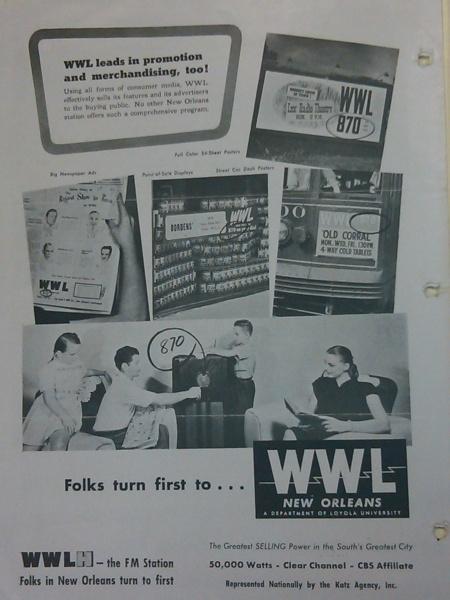
    <summary type="html"><![CDATA[<p><strong><em>WWL, Louisiana's first radio station, started broadcasting in 1922 as a means to raise funds for Loyola University. As a project of a Catholic University, WWL was bound by the rules of the Catholic Church, which forbid commercial practices. WWL found ways around this rule and proceeded to help furnish endowment funds for Loyola University. </em></strong></p><img src="https://neworleanshistorical.org/files/fullsize/8727c6c87c6adcaa76dd415c44714ccb.jpg" alt="WWL Advertising Brochure. Louisiana Research Center Vertical Files, Tulane University. " /><br/><p>Loyola University formed WWL in 1922 for the simple purpose of raising funds. Loyola needed to raise $1.5 million in order to construct six new campus buildings. The call letters, WWL, had no specific meaning to Loyola University, as they were randomly assigned. </p><p>On March 31st, 1922, WWL began the history of broadcasting in Louisiana with its debut at 10:52am. The initial broadcast was a speech given by Father Edward Cummings. Father Cummings devoted part of his speech toward explaining the purpose of the radio station, saying, “We are organizing the radio operators in the state to spread the story of Loyola’s needs. Will you lend your support to our campaign, both by radio and individual effort which will aid us in making Loyola University one of the greatest institutions of learning in the Southland?” Following the speech, WWL played a musical selection by Giuseppe Farate of Tulane’s Newcomb College Faculty, who played an original piano composition.</p><p>Loyola operated WWL as a commercial station, but soon faced issues regarding Canon 142 of the Catholic Church. Canon 142 states “Clerics are forbidden to engage personally or through another in business or to carry on commerce whether for their own benefit of for that of others.” WWL got around this due to the fact that religious magazines and newspapers were allowed to sell advertising in order to cover the costs of operation. By devoting the same amount of time to educational and religious programming and commercial programming, WWL was able to continue its operations. </p><p>However, WWL's main purpose after 1929 was to furnish endowment funds for Loyola University, which held its license. Loyola then formed WWL Development, which was a privately owned holding company run by local businessmen that operated WWL. WWL Development would then compensate Loyola for the revenue the station would bring in. One Loyola president described WWL Development as "a corporation of convenience which saves us Priest-Educators from dealing in the commercial world." </p><p><em><strong><a href="https://neworleanshistorical.org/items/show/1123">For more view the original article</a></strong></em></p>]]></summary>
    <published>2016-03-06T20:52:26+00:00</published>
    <updated>2026-08-24T00:36:24+00:00</updated>
    <link rel="alternate" type="text/html" href="https://neworleanshistorical.org/items/show/1123"/>
    <id>https://neworleanshistorical.org/items/show/1123</id>
    <author>
      <name>Jesse Chicco, Logan Kelley, Daniel Martin, Nicole Schubert,&amp;#32;&amp;amp;&amp;#32;Kathryn O&amp;#039;Dwyer, Editor</name>
    </author>
  </entry>
  <entry>
    <title type="html"><![CDATA[Audubon Park]]></title>
    <summary type="html"><![CDATA[<p><strong><em>Sandwiched between St. Charles Avenue and the Mississippi River, is the lush urban oasis- Audubon Park. Named after naturalist John James Audubon, the park is used for outdoor recreation of all kinds. Purchased by the city in 1871, the site has played host to several notable historical events and has undergone numerous changes.</em></strong></p><img src="https://neworleanshistorical.org/files/fullsize/0554fe226f86be2a22b22557b6cc65c4.jpg" alt="&quot;Avenue of live oaks, Audubon Park, New Orleans, La.&quot; " /><br/><p><span style="font-weight:400;">The site of Audubon Park today was once a twelve and one-half arpent plantation bought and owned by Pierre Foucher. Foucher abandoned his plantation before the Civil War and fled to France, never returning to Louisiana. The abandoned plantation was used by both the Confederate and Union sides during the war. It was used as a campground for Confederate troops and as a site for a Union military hospital that existed for five years. For almost a decade following, the eye sore of a plot was sold back and forth between wealthy citizens, legislators, and park commission boards. The city of New Orleans purchased the park in 1871. Originally dubbed Upper City Park, a commission was established in 1879 to maintain the land, however the only financial assistance given for operating a park on the site came in the form of revenue from leasing the grounds for grazing. [1]</span>
<span style="font-weight:400;">The early history of the park’s development begins with the site being chose for the World’s Industrial and Cotton Centennial Exposition of 1884-85. To learn more about the exposition see visit our other tour </span><a href="https://neworleanshistorical.org/tours/show/14"><span style="font-weight:400;">“Audubon Park: Site of the 1884 Cotton Centennial Exposition.”</span></a>
<span style="font-weight:400;">Following the exposition, New Orleans City Council created a new park commission to operate the park in May 1886. </span><span style="font-weight:400;">In 1900 John Charles Olmsted was hired as the park’s designer. His master plan took twenty years to implement, mainly due to a lack of funds. Plans were further delayed and altered by the board’s decisions to lease the park’s riverfront to the Corps of Engineers, and allow the constructing of railroad tracks along the river and the operation of a sugar experimentation station. [1, 2] Much of the original Olmsted design was compromised to evolve the neighborhood park into a place where “people from varied backgrounds wanted to come for recreational pursuits.” Such compromises included the addition of various structures for active recreation such as swimming, tennis, and softball. Most of these were financed by private donors as memorials. Numerous memorials erected during this time (1916-1920s) still stand in the park today. These include Moise Goldstein’s neoclassical St. Charles Avenue entrance, the numerous gazebos, Emile Weil’s Newman Band Stand, the Gumbel Fountain, the Hyams wading pool, and the Popp floral gardens. [3]</span>
<span style="font-weight:400;">In the year 1924, the park’s visitors numbered over a million each year. New Orleans native Mary Lou Widmer recalled her childhood outings to the park during the depression years:</span>
<span style="font-weight:400;">“A day was set aside, the family was collected, and the long ride began. Our old car wove in and out of those unfamiliar uptown streets, loaded with kids, a picnic lunch and our cooler full of root beer…What a pool Audubon Park had! […] The bathhouse was a wonder in itself. I remember the endless row of lockers, the changing booths, and the huge, mirrored room with hairdryers in the wall. I loved the various facilities. I enjoyed changing my clothes in a private booth, wearing my jingling locker key pinned to the belt of my bathing suit, and running through the hallway of shower jets that sprayed me just before entering the revolving door-way to the pool. These were all spiffy new things we did not have at the City Park pool.” [1]</span>
<span style="font-weight:400;">Today, the park continues to thrive, as it has for over a century, as a mecca for outdoor recreation of every kind. People continue to visit the Park to take full advantage of “the alleys of ancient live oaks, the tranquil 1.8 mile jogging path, the lagoon, picnic shelters, playgrounds, tennis courts, and soccer fields.” [4] The park has been the site of numerous cancer walks, charity events, golf tournaments, and various fundraisers. [5]</span></p><p><em><strong><a href="https://neworleanshistorical.org/items/show/1093">For more (including 3 images) view the original article</a></strong></em></p>]]></summary>
    <published>2016-03-06T20:30:53+00:00</published>
    <updated>2026-07-15T16:20:30+00:00</updated>
    <link rel="alternate" type="text/html" href="https://neworleanshistorical.org/items/show/1093"/>
    <id>https://neworleanshistorical.org/items/show/1093</id>
    <author>
      <name>Sierra Motsinger, Rosie Polins, Laura Garcia, Enkhsaikhan Enkhbat,&amp;#32;&amp;amp;&amp;#32;Kathryn O&amp;#039;Dwyer, Editor</name>
    </author>
  </entry>
  <entry>
    <title type="html"><![CDATA[Mahalia Jackson]]></title>
    <summary type="html"><![CDATA[<p><strong><em>Mahalia Jackson, also known as the Queen of Gospel, was born and raised in New Orleans. In 1995, the performing arts center located in Louis Armstrong Park was name in her honor.</em></strong></p><img src="https://neworleanshistorical.org/files/fullsize/e3d486dba139c2a81757ab627ceb31f7.jpg" alt="Close up of &quot;Portrait of Mahalia Jackson.&quot;" /><br/><p><strong>Mahalia Jackson</strong> </p><p>Often referred to as the “Queen of Gospel,” Mahalia Jackson was one of the most influential figures for contemporary gospel and blues singers. Born in 1911, Jackson grew up in a shotgun home in New Orleans. She quickly found her greatest refuge at Mt. Moriah Baptist Church where she sang at least six times a week. It was at Mt. Moriah that her talents were first recognized. At the age of sixteen, Jackson moved to Chicago with her aunt in order to seek better employment opportunities. In Chicago, Jackson joined the Greater Salem Baptist Church. </p><p>Jackson's career would not take off until the late 1940s, after a failed record deal and many years of touring. With her success, she frequented radio stations and performed as the headliner at Carnegie Hall. In the 1950s, Jackson regularly appeared on television shows hosted by Ed Sullivan, Dinah Shore, and Steve Allen, and departed on her first European tour. </p><p>Jackson was involved in the Civil Rights Movement, she lent her voice to rallies, marches, and demonstrations throughout the country. In 1963, during the historic March on Washington, Jackson performed "I Been 'Buked and I Been Scorned" before Dr. Martin Luther King gave his "I Have a Dream" speech. Jackson later sang at John F. Kennedy’s presidential inauguration, as well as his funeral, and the funeral of Dr. Martin Luther King. </p><p>After collapsing in 1971 on tour in Munich, Jackson died early the next year of heart complications in her home in Chicago. </p><p><strong>The Theater</strong></p><p>Designed by architect William Bergman, the theater was first opened in 1973 as The New Orleans Theater for the Performing Arts. Its 2,100 seats were filled up with those citizens of New Orleans who sought to be entertained by some of the finest performers in the city. Jazz and gospel singers, brass bands, ballet companies, and other performers of the fine arts regularly performed here. The first performance to play at the theater was The New Orleans Philharmonic Symphony Orchestra, and they entertained a full house with Giuseppe Verdi's Manzoni Requiem. </p><p>In 1995, the New Orleans City Council and Mayor Marc Morial, with grants from New Orleans Jazz and Heritage Foundation and the Louisiana Division of the Arts, renamed the New Orleans Theater for the Performing Arts after the New Orleans-born Gospel singer Mahalia Jackson. </p><p><strong>Theater Renovation</strong> </p><p>The Mahalia Jackson Theater suffered significant water and wind damage during Hurricane Katrina. The theater was renovated and reopened in 2009.</p><p><em><strong><a href="https://neworleanshistorical.org/items/show/977">For more (including 2 images) view the original article</a></strong></em></p>]]></summary>
    <published>2016-03-06T19:33:47+00:00</published>
    <updated>2026-07-15T16:20:31+00:00</updated>
    <link rel="alternate" type="text/html" href="https://neworleanshistorical.org/items/show/977"/>
    <id>https://neworleanshistorical.org/items/show/977</id>
    <author>
      <name>Jenidza Rivera&amp;#32;&amp;amp;&amp;#32;Tulane University Students</name>
    </author>
  </entry>
</feed>