Praline or "Pecan Candy"
Text
Pralines are thought to have originated in seventeenth-century France when the chef of César, Duc de Choiseul, Comte du Plessis-Praslin coated almonds with sugar. While sugared nuts were already enjoyed throughout the world, the candy termed "praline" became a popular treat in France, in part because of their lucrative sugar colonies in the Caribbean. The French settlers in Louisiana brought the praline tradition with them.
African-American cooks working in the French colonists' kitchens transformed the sugared-almond praline. Because of their abundance, pecans replaced almonds and milk was added. The final product was a sweet, creamy patty filled with pecans.
African-American women throughout the 1800s could be found selling pralines in various parts of New Orleans. The praline women would become the most popular of New Orleans street vendors, and they were often found around Jackson Square.
As the tourism industry expanded in the early 1900s and praline stores opened throughout the French Quarter, many businesses employed a racist, "mammy" caricature of the praline women to sell their candies. Some businesses placed life-sized images of "praline mammies" in front of their stores to attract customers. Many tourists posed themselves alongside these gross depictions of the praline vendors.
The stereotypical image has all but disappeared from New Orleans' streets, but the praline remains one of the city's most sought-after foods as well as a popular treat made in home kitchens throughout New Orleans and other parts of the South. In the 21st century, entrepreneurial vendors continue to conduct their own business, often using social media. African-American fans of the delicacy often use the term "pecan candy" or "praline" to refer to the treat.
Files

Creolized Pralines
Pecans replaced the almonds and milk was added. The final product was a sweet, creamy patty filled with pecans; the Louisiana sugar industry played a major role in changing the old world treat. Image: Chanda Nunez
César, duc de Choiseul, comte de Plessis-Praslin, 17th Century
Pralines are thought to have originated in seventeenth-century France when the chef of Marshal du Plessis-Praslin coated almonds with sugar. When the French settlers came to Louisiana, the creolization process led to a new form of the treat. Image: Public Domain
Praline Vendor, Newcomb College, Tulane University
African-American women sold pralines in various sections of New Orleans. This vendor was a fixture on the campus of Tulane University's college for women. Later, her daughter took over her business. Though often treated dismissively by white observers, these were independent business women who either worked for themselves or supplemented their regular wages. | Source: Courtesy of Vorhoff Library and Newcomb Archives, Newcomb College Center for Research on Women, Tulane University
Praline Woman, French Market
The praline women became one of the most popular of the street vendors. These entrepreneurs dressed in long skirts and aprons with their heads wrapped in tignons and scarves draped around their necks. They carried umbrellas to shade themselves and fans made from palm fronds to keep the flies away from their pralines. The praline women always carried large wicker baskets, which held the many varieties of pralines, including coconut and peanut. | Source: Courtesy of the Collections of the Louisiana State Museum.
Praline Vendor
The praline women were so iconic that artists created numerous interpretations of them. Such paintings and sketches depict the vendors sporting a tignon and long skirts with her pralines in a basket. | Source: Courtesy of Vorhoff Library and Newcomb Archives, Newcomb College Center for Research on Women, Tulane University.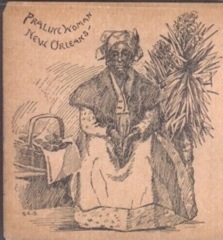
"Praline Woman, New Orleans"
Source: Courtesy of Vorhoff Library and Newcomb Archives, Newcomb College Center for Research on Women, Tulane University.
"Aunt Sally's Original Creole Pralines"
The tourism industry generated praline businesses throughout the French Quarter, and most used the caricatures of the praline women to sell their candies. The warped image could be found on praline boxes, bags, and in newspaper advertisements. "Look for Mammy with the Blinking Eyes," states the souvenir box top. | Source: Image courtesy of Chanda M. Nunez.