936 St. Peter Street: A Cottage Industry in the Quarter
Text
In 2014, the University of New Orleans was invited to conduct archaeological testing at 936 St. Peter Street while the property was undergoing renovations. Below the surface layer, archaeologists discovered the opening of a privy shaft. The privy was brick-lined with a wood-lined base.
The privy deposit appeared to represent a single, rapid deposition, probably within the time frame of the 1860s. This rapid deposition likely happened at the time of a clean-out and renovation of the rear building, when the use of this privy was abandoned due perhaps to shifting use of the outbuilding. The privy fill contained a significant quantity of typical domestic debris from the mid-nineteenth century: ceramic tablewares, including whiteware, ironstone, and porcelain; chamber pots; glass bottles; and smoking pipes.
What stood out most during the excavation of the privy was the abundance of animal remains, especially the number of elements from skulls. When a rough count was taken of the entire assemblage, the privy feature was found to contain a total of 147 Caprine (goat or sheep) skulls.
So, what could explain the heavy presence of goat and/or sheep skulls in the privy feature at 936 St. Peter Street? There are, of course, a number of cuisines in which brains are a delicacy, and dishes, particularly stews, in which goat heads play a prominent role, especially in African and Caribbean cultures. However, certain features of this assemblage taken together with other artifacts from the privy suggest that the faunal assemblage recovered from the privy at 936 St. Peter Street is representative of more than just urban diets.
An analysis of the butchery marks found on faunal material can indicate differences in patterns of faunal utilization. Analysts recorded the number of cuts, chops, fractures, shears, and saw marks present on each bone to determine if there were differences in butchery methods between different species. Most of the bones that were present were utilized as typical food sources and were from the postcranial skeleton. Some of these bones were either sawn or shorn (as with a sharp cleaver), marks that are typically made by a butcher or someone familiar with animal slaughter. However, an inordinate number of the butchery marks present on Caprine remains were indicative of cracking into the skulls to retrieve the brains inside, as evidenced by shearing and chop marks across the back of the skulls.
It is likely that the abundance of goat skulls and their associated butchery patterns represent the production waste from household-level tanning and hide processing, probably for use in fine leather work. Historical documents and ethnohistorical observations note the use of animal brains in the process of hide tanning, particularly when making buckskin.
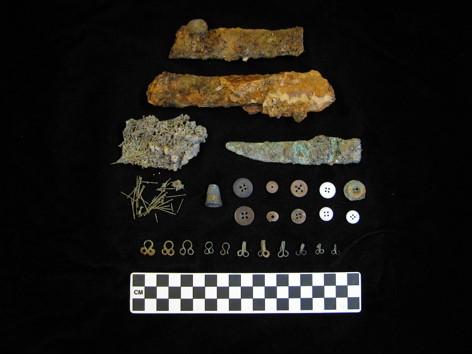
The sheer quantity of goat skulls in relation to other skeletal elements point to the likelihood that the goat brains were being put to a use in manufacturing rather than being consumed. Some of the other artifacts from the privy also support the connection of the assemblage to leatherwork. An abundance of cuprous metal straight pins, some occurring in clumps corroded together, were found within the privy fill along with thimbles, buttons, and hook and eye fasteners. While these items are not atypical finds at urban sites, their abundance is suggestive. Likewise, household production is suggested by some other artifacts in the assemblage, including knives, folded strap-metal, and a lace bobbin, all of which may be associated with hide production and its associated activities.
The growth of industrialization and urbanization in the late-eighteenth century had far reaching impacts on developing cities. Urban centers, like New Orleans, rapidly became crowded and dirty. Modes of production were centered around the household with production typically taking place within household lots or near the residences of employers. But as the city continued to expand during the nineteenth century, concerns over sanitation and urban waste disposal resulted in the segregation of nuisance industries, such as slaughterhouses and tanneries, to the outskirts of town. Still, small-scale manufacturing persisted, with household-level production only loosely regulated, despite the potential health issues it could generate.
This historical shift from cottage to commercial industry resulting from urban growth provides a lens through which we may interpret the archaeological assemblage at 936 St. Peter Street. This property was a very small urban lot in what had come to be a distinctly residential area by this time, and it is not hard to imagine the foul mess that the work of splitting hundreds of animal skulls and extracting the brains would incur in a residential yard . The noisome byproduct, and likely the complaints from neighboring tenants, may explain the rapid deposition of the privy contents and the renovation of the outbuilding in the 1860s. Perhaps the landlord at 936 St. Peter and/or their neighbors were no longer willing to tolerate a back yard covered in blood and Caprine effluvia. Rather than cleaning out privy contents from this period, the landlord or new residents instead built a completely new outbuilding and privy altogether, burying the putrid cranial decay until archaeological excavations uncovered it a century and a half later.
Files

Goat skulls found from the privy at 936 St. Peter Street
Source: University of New Orleans Department of Anthropology and Sociology. | Date: 2014
Photograph of 936 St. Peter Street at the time of excavation.
Two buildings occupy the property: a one-and-a-half story creole cottage on the street-front and a three-story outbuilding on the rear of the lot. Excavations at the site were concentrated within the footprint of three-story outbuilding. All of the privy fill was excavated, and almost 100% of the inundated soils were water screened through fine mesh, producing an unusually complete record of the contents. | Source: University of New Orleans Department of Anthropology and Sociology. | Date: 2014
Gridded excavation area at 936 St. Peter Street.
Source: University of New Orleans Department of Anthropology and Sociology. | Date: 2014
University of New Orleans students and volunteers excavating the privy at 936 St. Peter Street
Source: University of New Orleans Department of Anthropology and Sociology. | Date: 2014
File #6422: [Untitled]
The fur trade has a long history in Louisiana, from the pre-contact period through the development of the colony, and it became a benchmark in the development of the local economy. | Source: Google Images | Date: 2018
Photograph of a galley pot from the 936 St. Peter Street privy.
This galley pot was from the pharmacy of Christoval Espinola, who was in business from about 1861 to 1867. This date range serves as the terminus post quem (TPQ) of the assemblage from 936 St. Peter Street. A TPQ is the latest known date of manufacture for an item; this provides a benchmark date for the household ca. 1860. | Source: University of New Orleans Department of Anthropology and Sociology. | Date: 2014
Photograph of the privy excavations at 936 St. Peter Street.
Source: University of New Orleans Department of Anthropology and Sociology. | Date: 2014
Faunal analysis table of the privy contents excavated in 2014
Animal remains from one 10 cm level within the privy were fully analyzed in the archaeology laboratory at the University of New Orleans. A rough sorting of the remaining faunal material indicated that the analyzed sample was representative of the whole faunal assemblage. Each bone within the analyzed sample was identified to the most precise taxonomic level possible. Man-made alterations to the bones were also recorded along with several other interpretive categories. A total of 1,416 bones or bone fragments were recorded. Of those, 457 were identified to family, genus, or species. When the Percent NISP (or Number of Identified Specimens) was calculated for the ten identified taxa, Caprine bones and fragments comprised over two-thirds (69%) of the identified specimens. Goats and sheep are notoriously difficult to differentiate skeletally, and, thus, elements falling into the sheep/goat range are generally identified as Caprine. | Date: 2014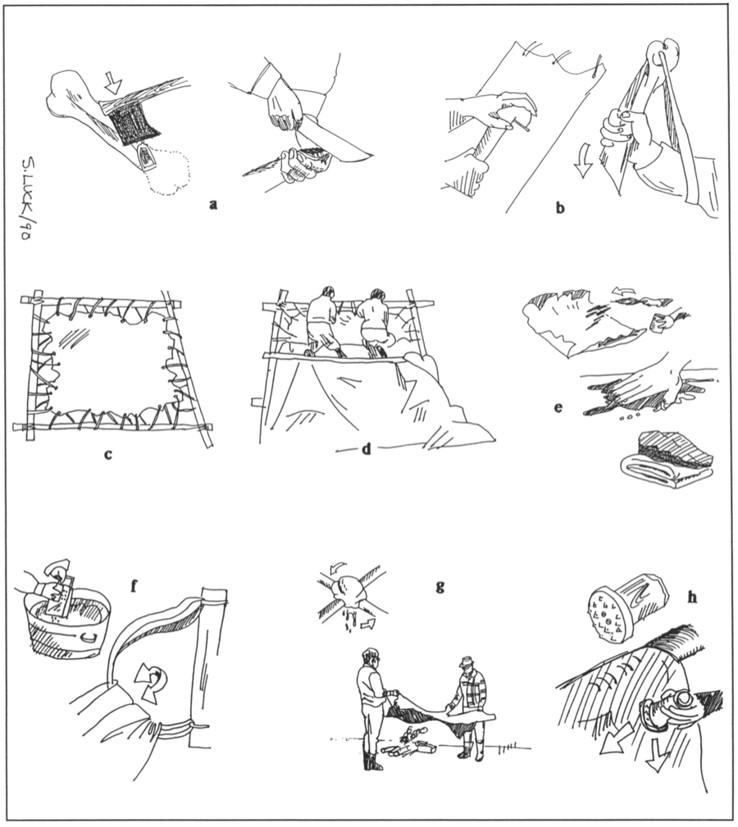
Birchbark Industry and Brain Tanning in the Central Canadian Subarctic
Source: Arctic Anthropology | Date: 1991
A cracked Caprine skull from 936 St. Peter Street with comparison.
A cracked Caprine skull from 936 St. Peter Street with comparison. | Source: UNO Department of Anthropology and Sociology.