Rodolphe and Daniel Desdunes
Text
Born in New Orleans in 1849, Rodolphe Desdunes actively participated in the city’s Creole social and political scene, eventually co-founding the Comité des Citoyens (Citizens’ Committee) in 1891. As the son of Pierre Feremie Desdunes, of Haitian ancestry, and his Cuban mother Henriette, Desdunes lived as a free person of color. Their family made a living growing tobacco and making cigars. Desdunes turned to education and studied law at Straight University, a historically Black college, and taught at The Institut Catholique, educating African American orphans. Between 1879 and 1912, he intermittently worked at the United States Customs House at 423 Canal Street as a messenger and clerk. In addition, Desdunes served as a member of the state militia and fought at the three-day Battle of Liberty Place against the White League, made of five thousand paramilitary ex-Confederate soldiers from the Democratic Party. The White League overpowered the state militia and local police force and overran the State Capital in New Orleans to protest the 1872 governor’s election results. This was just one of the many incidents of racial violence that characterized the Reconstruction era in Louisiana.Like many Black Americans of the time, Desdunes’s radical politics found a home in the Republican Party. Between jobs at the Customs House, Desdunes penned the political ideas of Black Creoles like himself. He wrote for two local Black newspapers, The Louisianian and The Crusader, and composed many articles meditating on ideas about public rights and equality, and called for civil rights for Black Americans and Black Creoles. At The Crusader, Desdunes, working closely with other Creoles of color such as Louis Martinet and Aristide Mary, and helped form the Comité that opposed racial separation and devised a legal strategy to challenge the Separate Car Act of 1890, which legally segregated passenger rail cars in Louisiana. In The Crusader, Desdunes explained the humiliating impact of the SCA: “Among the many schemes devised by Southern statement to divide the races, none is so audacious and insulting as the one which provides separate cars for black and white people on the railways running through the State. It is like a slap in the face of every member of the black race, whether he has the full measure or only one-eight of that blood,” he wrote in 1891. The Comité concocted a plan with Rodolphe Desdunes’s eldest son Daniel to contest the law. In February of 1892, Daniel boarded a white rail car at the Pontchartrain Railroad Depot at the corner of Elysian Fields and Decatur Street, headed for Mobile, Alabama. Desdunes’s civil disobedience caused an immediate stir, and the train was stopped at the Louisville-Nashville line split just north of Claiborne Avenue on Elysian Fields, where Lowe’s Home Improvement is currently located. Daniel was removed from the train and arrested, which allowed the Comité to challenge the Separate Car Act (SCA) of 1890 in court. Local Judge John Ferguson acquitted Daniel Desdunes, ruling that the Separate Car Act could not be enforced since the train he boarded traveled into other states. The SCA only had jurisdiction over travel within Louisiana. Learning from this mistake, the train Homer Plessy boarded a few months later traveled within the state of Louisiana, thus setting the stage to challenge the Separate Car Act. Plessy v. Ferguson put the radical politics of Desdunes and his colleagues on the Comité into action, launching a national fight for civil rights in the 1890s.
Files

Rodolphe Desdunes
A photograph of Rodolphe Desdunes. | Source: “Nos hommes et notre histoire : notices biographiques accompagnées de reflexions et de souvenirs personnels : hommage à la population créole, en souvenir des grands hommes qu'elle a produits et des bonnes choses qu'elle a accomplies / par R.-L. Desdunes,” The Historic New Orleans Collection, Permanent Collection, https://catalog.hnoc.org/web/arena/search#/entity/thnoc-archive/59-110-L/nos-hommes-et-notre-histoire-%3A-notices-biographiques-accompagnees-de-reflexions-et-de-souvenirs-personnels-%3A-hommage-a-la-population-creole%2C-en-souvenir-des-grands-hommes-quelle-a-produits-et-des-bonnes-choses-quelle-a-accomplies-%2F-par-r.-l.-desdunes.
Daniel Desdunes
Son of Rodolphe Desdunes who boarded a train car in 1892 to contest the Separate Car Act. Although the attempt was unsuccesful, it set the stage for the upcoming Plessy v. Ferguson case. | Source: Wikipedia, https://en.wikipedia.org/wiki/Dan_Desdunes#/media/File:DanDesdunes1911.jpg.

Straight University
Rodolphe Desdunes attended Straight University where he studied law. Other members of the Comité, such as Louis Martinet, also attended Straight. Their legal education here helped formulate the Plessy v. Ferguson case. | Source: “Leaflet for Straight University, 1884-85 school year,” 1884-1885, Straight University and Professor H.H. Swain Collection, MSS 908, Williams Research Center, The Historic New Orleans Collection, https://catalog.hnoc.org/web/arena/search#/entity/thnoc-archive/MSS%20908.1.22.2/leaflet-for-straight-university%2C-1884-85-school-year.
Straight University
Straight University, shown in the bottom photograph, circa 1908. | Source: “Schools And Colleges,” 1908, The Historic New Orleans Collection, Permanent Collection, https://catalog.hnoc.org/web/arena/search#/entity/thnoc-archive/1990.51.2.19%20i-vi/schools-and-colleges.
The Battle of Liberty Place
The Battle of Liberty Place took place in 1874. Rodolphe Desdunes served in the state militia that attempted to thwart 5,000 members of the White League protesting the 1872 election from taking over the statehouse in New Orleans. The Battle of Liberty Place is one of several examples of racial and political violence that occurred in Louisiana during Reconstruction. | Source: "The Louisiana Outrages - Attack upon the police in the streets of New Orleans," October 3, 1874, The Historic New Orleans Collection, Permanent Collection, https://catalog.hnoc.org/web/arena/search#/entity/thnoc-archive/1974.25.9.226/the-louisiana-outrages---attack-upon-the-police-in-the-streets-of-new-orleans.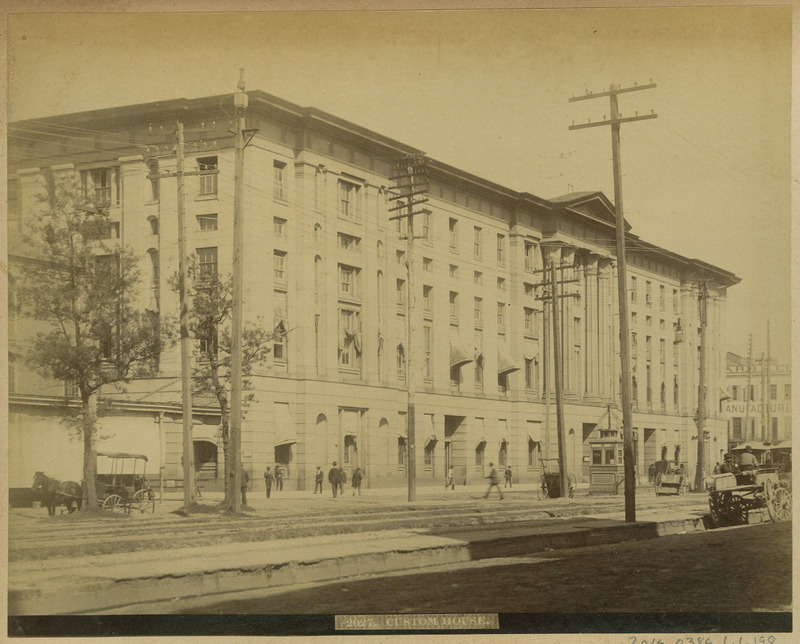
US Customs House
Rodolphe Desdunes worked at the US Customs House at 423 Canal Street in New Orleans to make a living while he worked on his civil rights activism. | Source: “Customs House,” 1884-1894, The Historic New Orleans Collection, Permanent Collection, Gift of Ms. N. West Moss, https://catalog.hnoc.org/web/arena/search#/entity/thnoc-archive/2016.0386.1.1.198/custom-house.
Customs House, interior
The interior of the Customs House. While employed here, Desdunes wrote numerous articles about public rights, racial equality, and justice. | Source: “(i) Grand Stairway. (ii) Custom House - Marble Hall,” 1892, The Historic New Orleans Collection, Permanent Collection, https://catalog.hnoc.org/web/arena/search#/entity/thnoc-archive/1970.29.7%20i%2Cii/(i)-grand-stairway.--(ii)-custom-house---marble-hall.