Enslaved Bakers and the Foreign French: D’Aquin, Bouny, and Poincy Bakeries
Text
Before the Civil War, enslaved labor was an integral part of the commercial baking industry and the overall economy in New Orleans. While food historians note the role that French, Spanish, and Anglo colonial bakers played in shaping the city’s early bread-making traditions, they often exclude the contributions of enslaved Africans, Free People of Color, and Afro-Creoles from the narrative.[1] By tracing some of New Orleans' antebellum bread bakers' history and piecing together fragments from the archives (legal documents, census records, fugitive slave advertisements) a parallel story of forgotten forced labor unfolds.
Records show several prominent antebellum bakeries in the French Quarter, including those belonging to Louis D’Aquin, Widow Bouny, and Paul Desdunes Poincy, who relied on enslaved labor. [2] The above-mentioned bakery owners worked within a two-block radius of each other, respectively located at 840-842 Royal Street, 921-25 Chartres Street, and 530-36 Dumaine Street. They were members of an exodus from the West Indies to Louisiana in the 1790s and early 1800s following the Saint-Domingue revolution (present-day Haiti). This wave of refugees, referred to as the Foreign French, fortified a dwindling French presence in New Orleans in the face of encroaching Americanization. Many of these white refugees from the West Indies were involved in the trades and crafts, including baking. [3]
Enslavers profited from the skills of enslaved bakers but often placed little value on keeping families intact. Advertisements list for sale or lease “machinery and fixtures for carrying on the baking business with or without 6 negroes, all superior bakers.” [4] An 1847 auction advertisement in the Times-Picayune lists the names of twenty enslaved persons, all fluent in French and English, with a wide range of skills, including the following experienced bakers:
“Washington – aged 32 years, excellent baker, capable of taking charge of any bakery. Jacob – aged 27 years, good baker, salesman, and oven man. Bazile – aged 27, excellent miche baker and salesman, also, oven hand. Zeno – aged 24, baker, somewhat of a pastry cook, tailor and a remarkably handy boy. Barm – aged 24 years, excellent hard bread baker and understands the making of dough. Reuben – aged 25 years, excellent hard bread baker, hostler, coachman and valuable boy for taking care of horses. Monday – aged about 45 years, an excellent pastry maker, good confectioner and strictly honest.” [5]
An 1856 auction advertisement for the indebted “F. D’Aquin and Co.” bakery (the predecessor to Margaret Haughery’s Steam Bakery) lists the property for sale, including building leases, machinery, utensils, wagons, bread carts, horses, and thirty-eight enslaved persons, from age sixty-one to eighteen months. The advertisement lists the enslaved workers' skills, including oven repairman, flour sifter, dough mixer, yeast maker, carpenter, drayman, bread seller, and the types of bread baked (hard bread, soft bread, loaf bread). [6]
Fugitive slave advertisements illustrate the cruelty of slavery, with mention of injuries and physical bondage including chains, and neck and leg irons. Fugitive slave advertisements also show how enslaved bakery workers moved through the city and shared expert knowledge– both as vendors traversing the streets and markets, and as human property transferred between enslavers. Multiple listings suggest that some enslaved people who worked in bakeries made several attempts to escape bondage and that some even succeeded in their quest for self-emancipation. [7]
Labor is an essential foundation of the bread-making history of New Orleans. Whether brought into the business by family ties, economic necessity, or (in the case of slavery), force, the people who mixed dough, shoveled embers or hawked wares on the street reflect the complex multi-faceted history of New Orleans and its bread. Reinscribing enslaved people and their baking skills in this history demonstrates the significance of forced labor to the growth and development of one of the city’s most beloved and iconic industries.
Files

Street Scene 800 block Royal Street
View of the 800 block of Royal Street ca.1900. | Source: Image courtesy of Special Collections Division, Tulane University, Negative Number: 2-047-024. | Date: 1900?
840-42 Royal Street
840-842 Royal corner of Dumaine. Previous location of Louis D’Aquin’s Bakery. | Source: Courtesy of Historic New Orleans Collection. Photographer John Watson Riley 1/2/2011. 2_047_roya_840-842 | Date: 1/2/2011
919-25 Chartres Street
919-925 Chartres Street. The former site of Widow Bouny’s bakery. | Source: Courtesy of Historic New Orleans Collection. Photographer Dan S. Leyrer 08/21/1963. N-1601D | Date: 08/21/1963
Auction Notice
Notice of Bakery Auction | Source: Times-Picayune, 10 Nov. 1847, p. 3. | Date: 11/10/1847
D'Aquin Bakery Auction
Notice of auction by D’Aquin Bakery with a detailed description of enslaved bakers. | Source: Times-Picayune, New Orleans, Louisiana, March 31, 1856, page 3. | Date: 3/31/1856
Notices of Bakeries for Sale or Rent
Notices of bakeries for rent or sale. | Date: 6/15/1849; 11/12/1850
D'Aquin Kneading Machine
Notice by Louis D’Aquin of new kneading machine from France “Without the assistance of man, and without it being necessary for negroes to put their hands in it, whereby bread is infinitely cleaner.” | Source: Louisiana Advertiser, January 23, 1827. | Date: 01/23/1827
D'Aquin Bakery Sale Notice and News Article
Notice of Sale D'Aquin Bakery ; News Article on D'Aquin Bakery "City Intelligence." Times-Picayune, 22 Aug. 1848, p. 2. | Source: Daily Advocate (Baton Rouge) 25 March 1856, p.2; "City Intelligence." Times-Picayune, 22 Aug. 1848, p. 2.
Fugitive Slave Advertisements for BROWN, Bread-Seller
Two revealing fugitive slave advertisements for the same bread-seller, BROWN, revealing his resistance and knowledge of the city's streets. | Source: Times-Picayune June 14, 1846, p. 2; Times-Picayune March 12, 1847, p.3. | Date: 6/14/1846; 3/12/1847
Fugitive Slave Advertisements Showing Iron Bonds
Persistence and Resistance: Two Fugitive Slave Advertisements of Enslaved Bakery Worker PETER with Details of Physical Restraints, a Sign of Having Run Before. | Source: Times-Picayune December 15, 1847 p.3; Times-Picayune August 10, 1847 p. 3. | Date: 12/15/1847; 08/10/1847.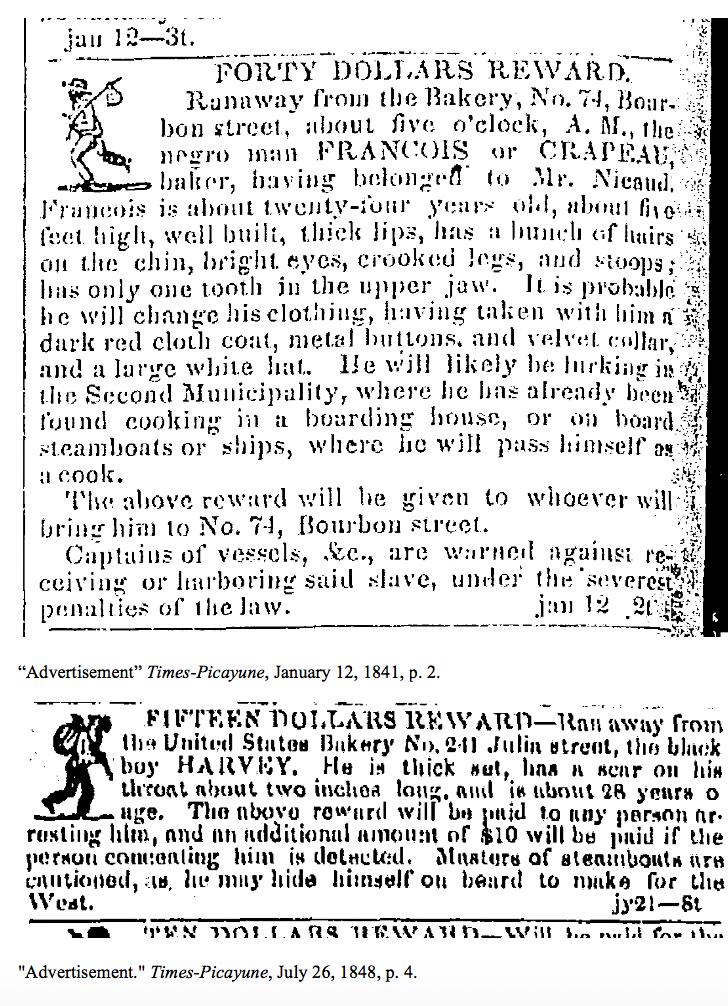
Fugitive Slave Advertisements of Bakers Heading to Steamships
Two Fugitive Slave Advertisements Looking for Enslaved Bakery Workers Possibly Heading to Work as Cooks on Steamships | Source: Times-Picayune January 12, 1841, p.2; Times-Picayune July 26, 1848, p.4. | Date: 01/12/1841;07/26/1848.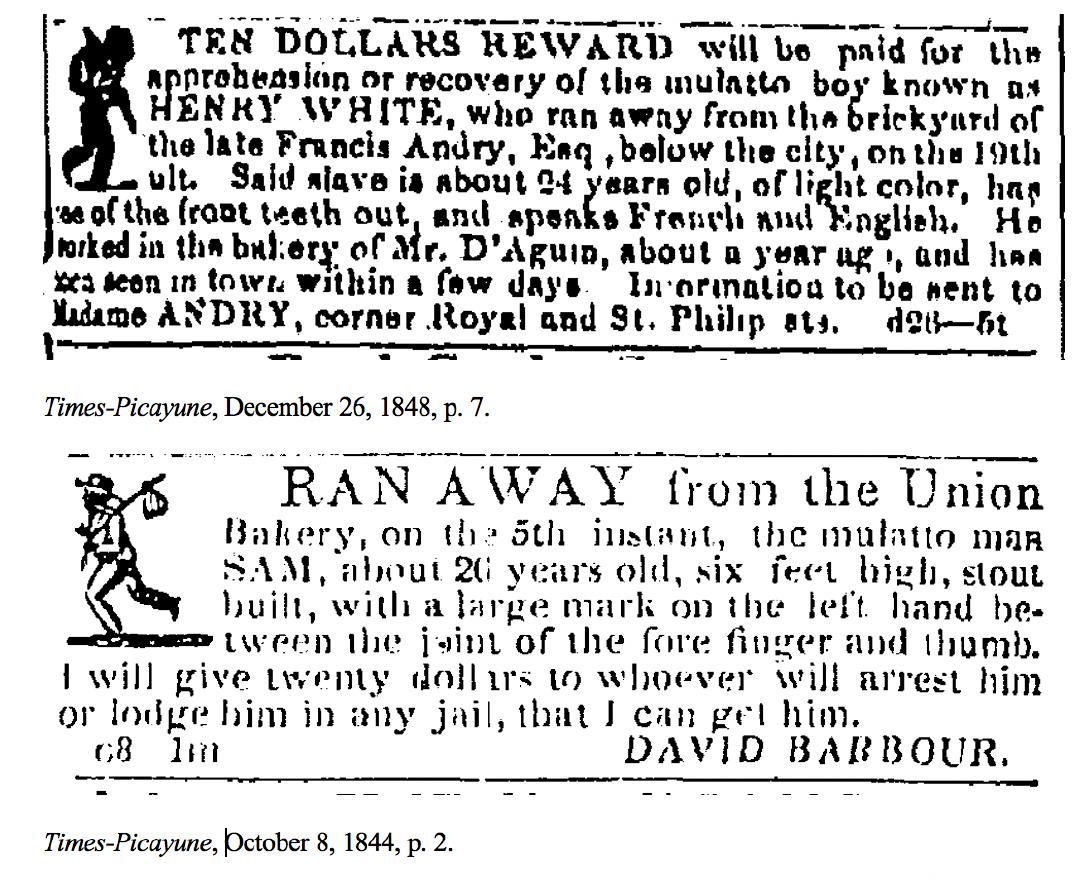
Fugitive Slave Advertisements D'Aquin Bakery and Union Bakery
Two Fugitive Slave Advertisements for Enslaved Bakery Workers | Source: Times-Picayune, December 26, 1848, p.7; Times-Picayune October 8, 1844, p.7. | Date: 12/26/1848; 10/08/1844.Map
921-25 Chartres Street, New Orleans, Louisiana
530-36 Dumaine Street, New Orleans, Louisiana