Madame John’s Legacy: 1971 Excavations by Richard Shenkel and UNO
Text
In 1971, Madame John’s Legacy was one of the first historic period sites in urban New Orleans to be systematically investigated, when the subdiscipline of historical archaeology was still in its relative infancy. These investigations, carried out by Richard Shenkel of the University of New Orleans, were primarily intended to help understand the construction chronology of Madame John’s. While it was known that the present incarnation of Madame John’s was constructed just after the 1788 fire had damaged or destroyed an existing structure on the lot, it was unclear whether or not this new construction was on the exact footprint of the older one. It was also unclear whether the building that was destroyed dated from the Spanish era, or whether it was the same one maintained by the Widow Pascal in the French era as an inn.
Files

Plan showing locations of previous excavations at Madame John’s relative to floorplan, with Shenkel’s excavations in yellow.
Source: Reproduced from Gray 2015. Courtesy of UNO Department of Anthropology and Sociology.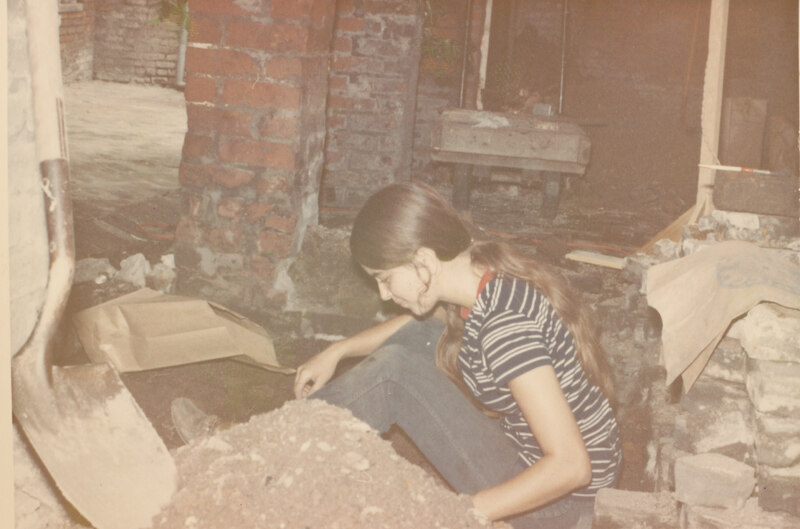
Member of UNO team excavating in interior of Madame John’s Legacy.
Source: Collection of UNO Department of Anthropology and Sociology.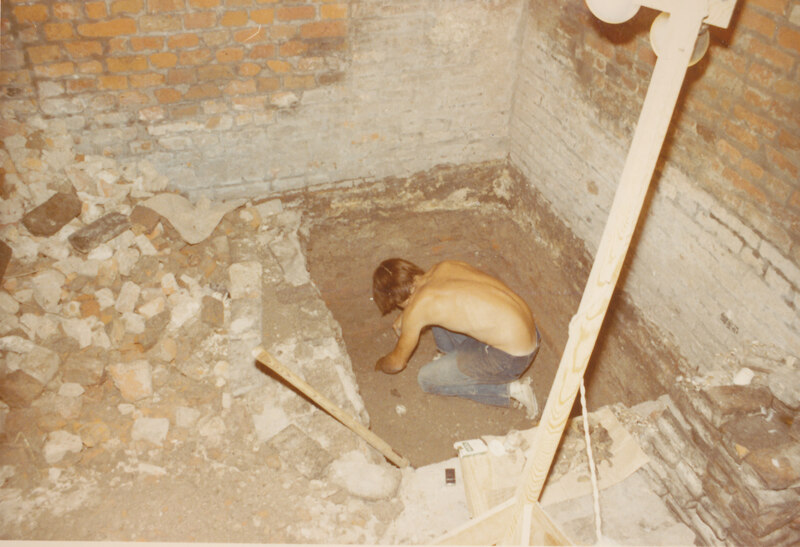
Member of UNO team excavating in interior of Madame John’s Legacy.
Source: Collection of UNO Department of Anthropology and Sociology.
Unit excavated in courtyard of Madame John’s.
A number of subsurface features were encountered in Shenkel’s excavations, including the remains of a wooden drainage system just beneath the brick floor in the interior. The soils encountered during excavations were characterized as a mixture of fills containing crumbled brick, architectural debris, and oyster shell, often mixed with soil characterized as “a very sticky gumbo”. | Source: Collection of UNO Department of Anthropology and Sociology.
Stoneware bottles from “W. Massey, New Orleans”, ca. 1840s.
Hundreds of fragments of stoneware bottles from the Massey firm were found in a layer in the courtyard, where they had apparently been reused as fill to raise the yard level. | Source: Photograph by Ryan Gray of objects now in collection of Louisiana State Museum, courtesy of UNO Department of Anthropology and Sociology.
Stratigraphic profile of Shenkel’s Unit VII, showing foundation of Madame John’s.
The excavations found at least a meter (3 ft) of accumulated fill before clay subsoil was reached in the units, including remains of an earlier French Colonial era structure (likely that belonging to the Pascals) deeply buried beneath the foundations and offset from them. | Source: Reproduced from manuscript on file, UNO department of Anthropology and Sociology.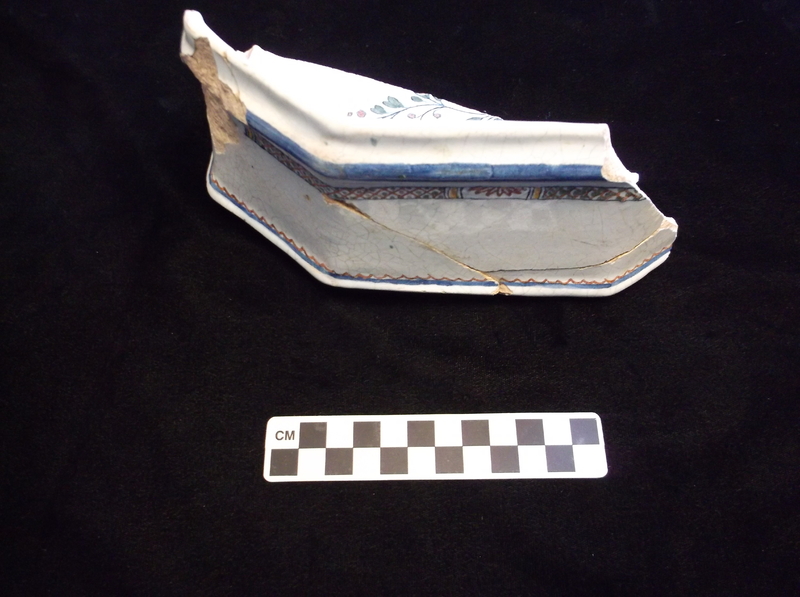
Polychrome faience vessel recovered in Shenkel excavations.
Shenkel’s excavations at Madame John’s, while not reported to the standards now typical in professional archaeology, were important in establishing what was then a new specialization in archaeology, the study of the recent past. The collections from all of the Madame John’s excavations are housed at the Louisiana State Museum, where they have been particularly useful to those studying the material culture of Louisiana in the Colonial era. | Source: Photograph by Ryan Gray of objects now in collection of Louisiana State Museum, courtesy of UNO Department of Anthropology and Sociology.
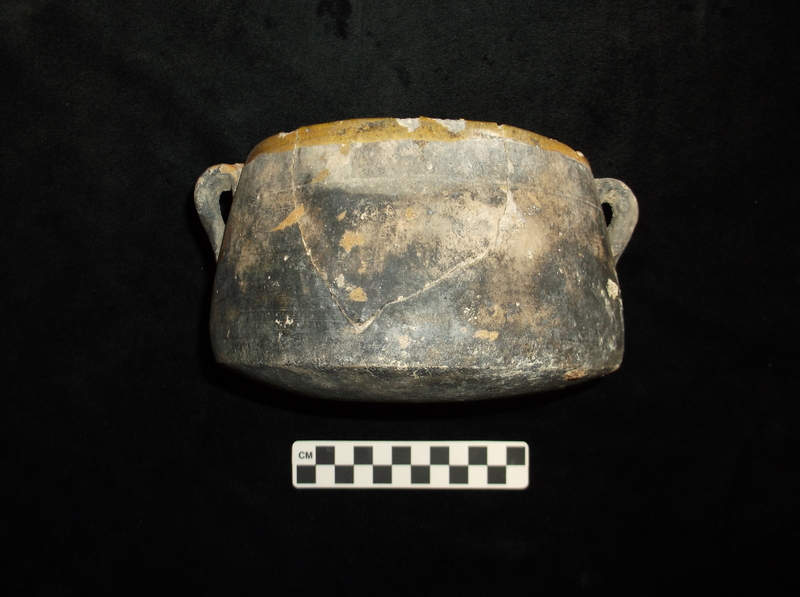
Hand-built pottery from Madame John’s.
Hand-built pottery, presumably of Native American manufacture, was also collected in 1971. The circulation of indigenous wares like this in the Colonial era city has emerged as an important research theme in archaeological studies of New Orleans. | Source: Photograph by Ryan Gray of objects now in collection of Louisiana State Museum, courtesy of UNO Department of Anthropology and Sociology.